The Halifax brand is changing to Lloyds
You can still apply for a Halifax mortgage and any applications you’ve already started will progress as usual.
Please choose one of the Criteria headings for a list of the topics under each, or select from the A-Z list.
You can also find a ‘Search’ tab on the right-hand side of the page to review our top questions or search our Criteria.
For anything you are unable to find you can use our ‘Chat to us’ webchat facility or contact your BDM.
-
- Certifying Documents
- Changing Property Address
- Cladding & EWS1
- Closed Applications
- Commitments and Outgoings
- Concessionary and family purchase
- Consent to let
- Contractors
- Convictions
- Decision in Principle (DIP)
- Dependants
- Deposit acceptance and documentation
- Direct Debit Details
- Discount Market Scheme (DMS)/ Resale Price Covenant (RPC)
- Distressed sale and leaseback
-
- Early Repayment Charges (ERCs)
- Employed by family business
- Employment/Self Employment Min Time
- Energy Performance Certificates (EPC)
- EWS1 and Cladding
- Existing Halifax Customer Moving Home
- ExPats
- Extending the mortgage offer
- Family Purchase/Concessionary
- Fee Payment - Acceptable Cards
- Financial Difficulty
- Finders Fees
- First Homes Fund (Scotland only)
- First Homes Scheme (England only)
- First Monthly Payment & Initial Interest
- First Time Buyers (FTB)
- Flying freeholds
- Foreign income
- Foreign nationals
- Foster income
- Further Advance
- Future Changes to Income and Commitments
-
-
- Max No of Applicants
- Maximum Working Age
- Min Time Employment and Self Employment
- Min/Max Age
- Mortgage Charter
- Mortgage Prisoner
- Mortgage Term
- Multiple Residential Mortgages
- Net Profit - Limited Company Directors
- New Build
- New Job, Pay Rise and Promotion
- Non-Sterling income (Foreign income)
- Non UK Nationals
- Number of Applicants
- Nursing Bank
- Overpayments
-
-
-
- Scottish Properties
- Second Charges
- Seafarer Contractors
- Second Home Loan
- Second Job
- Section 106 planning agreements / restrictive covenants
- Self-Employed Business Commitments
- Self-Employed Income Criteria
- Self-Employed Income Evidence Guide
- Shared Equity (including Help to Buy)
- Shared Equity – Further Advance
- Shared Ownership
- Solicitor panel
- Sub Sales & Back to Back transactions
- Subsequent Charges (SCG)
- Unacceptable Property Types
- Unencumbered Property
- Valuation
- Valuation Reports & Surveys
- Zero-hour contracts
- 1 year Self-Employed
- £5,000 Deposit mortgage
- 90-95 loan to value
- Acceptable Property Types
- Adverse Credit
- Affordability, Loan to Income (LTI) and Income Multiples
- Age Min/Max
- Appeal Credit Score Decline
- Applications for Family Members
- Arrears for PT & FA
- Assignable Contracts
- Back to Back Transactions & Sub Sales
- Background Mortgages (incl BTL) and Non-Simultaneous Sale
- Bank of England base rate changes
-
There are three questions which require the customer to disclose any history of previous adverse credit.
Question 1: Has any applicant, within the last six years, been one or more months in arrears on a mortgage, two or more months in arrears on any other type of debt, or ever had a property repossessed?
Question 2: Has any applicant had a County Court Judgement (CCJ) or default registered against them or their business (if self-employed) within the last six years?
Question 3: Has any applicant had a Bankruptcy/IVA/Debt Management Arrangement/Debt Relief Order or any Arrangement/Order with a debt management provider/creditor to pay less than the contractual payment, registered within the last 6 years (whether completed or not) or still outstanding (whenever registered)?
Adverse credit includes:
- County Court Judgments (CCJs)
- Defaults
- Arrears
- Bankruptcy
- Individual Voluntary Arrangements (IVAs)
- Debt Management Arrangements
- Debt Relief Orders (DROs)
- Company Voluntary Arrangements (CVAs)
The date the adverse credit was registered will determine whether it needs to be disclosed.
Question 1: Arrears and Repossessions
Answer 'Yes' if the customer has:
- Been 1 month or more in arrears on a mortgage within the last 6 years; or
- Been 2 months or more in arrears on any other type of debt within the last 6 years; or
- Ever had a property repossessed, regardless of when the repossession occurred.
Other debt includes:
- Catalogue accounts
- Store cards
- Loans
- Hire Purchase (HP)
A missed payment on a mobile phone account would not normally be classed as arrears, as it does not exceed 2 months.
Question 2: CCJs and Defaults
Answer 'Yes' if a CCJ or Default was registered within the last 6 years.
This applies whether the CCJ or Default is:
- Still outstanding; or
- Has since been satisfied or repaid.
CCJs and Defaults registered more than 6 years ago do not need to be disclosed.
Question 3: Bankruptcy, IVA and Debt Management Arrangements
Answer 'Yes' if the customer has:
- Been declared Bankrupt;
- Entered into an IVA, Debt Management Arrangement or Debt Relief Order; or
- Made a formal or informal arrangement with a creditor or debt management provider to pay less than the contractual monthly payment;
and either:
- The arrangement was registered within the last 6 years; or
- The arrangement remains outstanding.
A Bankruptcy Restriction Order must be disclosed if it remains outstanding.
Where a customer has agreed an arrangement within the terms of their credit agreement, such as a payment holiday, this does not need to be disclosed.
Time to Pay (TTP) arrangements with HMRC
A Time to Pay arrangement with HMRC does not normally need to be disclosed solely because it exists. HMRC does not typically report Time to Pay arrangements to credit reference agencies and they do not directly affect a customer's credit score.
Tax bills don’t need to be treated as a commitment.
-
Simultaneous sale and purchase is the preferred route, but we recognise that this is not always possible.
Existing property is for sale but will not be sold before new mortgage completes - The existing mortgage payment must be keyed as a credit commitment and will be included in the affordability calculation.
Existing property to be rented out - The mortgage payment must be keyed as a credit commitment (the mortgage type for the commitment needs to by keyed as ‘Buy to Let'). The rent received should be keyed as 'Rental Income (if rental property)'.
Other Buy-to-Let mortgaged properties owned - The mortgages must be keyed as individual credit commitments and the total rent received keyed as 'Rental Income (if rental property).
-
Spent or unspent criminal convictions can be considered subject to meeting overall affordability and lending policy as normal. A good consideration if your client is impacted by a conviction is to make sure they or another applicant if applicable can get building insurance as this a condition of the mortgage and must be place for all customers to proceed.
-
A dependant is anyone who is financially reliant on your customer, who is not a party to the mortgage and does not contribute to the mortgage payments. A dependant may be a child, spouse not party to the mortgage, adult or elderly relative or a future dependant.
You need to capture separately both Child and Adult Dependants.
Child Dependant
A child dependant would include any children for which the customer(s) is the primary carer and who is under 18. A child dependant would include a future dependant where the customer is expecting a baby or is in the process of adopting a child. Foster children should be included as dependants.
Where any children have income and can fully support themselves they do not need to be keyed as a dependant.
If a child is not living with the customer(s) and maintenance is being paid, a dependant does not need to be keyed, but the maintenance amount must be keyed as a commitment.
Adult Dependant
An adult dependant is someone who is not party to the mortgage but is financially reliant on the customer. This could be a spouse/partner, elderly relative or grown up children who are unemployed or in full time education.
Where the adult dependant resides at the property for some of the time, you would key this in the adult dependant field.
Alternatively, where the customer financially supports an adult dependant who doesn't reside at the property, they would not be keyed as a dependant, but the related costs instead must be keyed as a total figure in “Other Commitments”.
-
Deposit Requirements
What deposit is required?
Customers must provide the minimum deposit required for the product, scheme and their individual credit score. No part of the customer's personal deposit can be funded by a personal loan.
Evidence of deposit is not always required as part of the mortgage application process. You will be notified when the application is submitted if evidence is required.
Where evidence is not requested, the acting solicitor will verify the source of funds on our behalf.
Gifted Deposits
Can a customer use a gifted deposit? Yes.
A gifted deposit is acceptable where the:
- gift is from an eligible family member
- gift is not repayable
- person providing the gift will have no legal interest in the property after completion
- person providing the gift will occupy the property but not be named on the mortgage.
If any part of the deposit is gifted, you must select 'Gifted Deposit' as a source of deposit when the application is submitted. You need to do this even where multiple deposit sources are being used and the gifted amount is not the largest contribution.
Who can provide a gifted deposit?
Acceptable family members can provide a gifted deposit.
A family member is someone related to at least 1 applicant by birth, marriage, civil partnership or another accepted relationship. This includes:
- husband, wife or civil partner
- parents, stepparents and parents-in-law
- brothers and sisters, including half-siblings and step-siblings
- brothers-in-law and sisters-in-law
- children, stepchildren and adopted children
- sons-in-law and daughters-in-law
- grandparents and step-grandparents
- aunts and uncles (related by blood only)
- nephews and nieces
- common-law partners or co-habitees
- partners or former partners who do not live at the property being purchased.
Who cannot provide a gifted deposit?
Gifted deposits are not acceptable from:
- friends
- family friends
- employers
- vendors
- developers
- landlords (unless gifting equity via a concessionary purchase)
- cousins
- foster children or guardian children.
Can a gifted deposit come from overseas? Yes. However the donor must be an acceptable family member. At the time evidence is requested, the gifted funds must have been transferred into a UK bank account.
What evidence is required for a gifted deposit?
When evidence is requested, obtain either a letter from the family member providing the gift, or a completed Gifted Deposit Template Letter.
The letter must:
- be addressed to Lloyds Banking Group or relevant brand name
- be dated within the last 3 months
- include the name and address of the person providing the gift
- include the name and address of the applicant(s)
- confirm the relationship between the donor and applicant(s)
- include the property address being purchased
- confirm the gifted amount
- confirm the source of the gifted funds
- confirm the gift is not repayable
- confirm the donor will have no legal interest in the property following completion
- be signed by the person(s) providing the gift.
What evidence of funds is required?
Provide 1 of the following:
- A UK bank statement.
- A UK passbook.
- A letter from a UK bank confirming the funds are available.
Additional evidence may be requested where required.
Savings
Can a customer use savings as their deposit? Yes.
What evidence is required for savings?
Provide 1 of the following:
- The latest 3 months of UK bank statements.
- A UK passbook covering the latest 3 months of transactions.
- The latest annual statement for a longer-term savings plan.
The evidence must:
- be in the name of at least 1 applicant
- show sufficient funds to cover the deposit required.
Will additional information ever be required for savings? Yes.
We may request:
- an explanation of any recent large or unusual deposits. For example, an inheritance which is acceptable
- accountant confirmation that withdrawing business funds will not negatively affect the business.
Forces Help to Buy (FHTB)
Can a customer use a Forces Help to Buy loan as a deposit? Yes.
Serving members of HM Forces may use a Forces Help to Buy (FHTB) loan as a deposit.
The loan can be used for:
- a customer's main residence
- a property purchased using the Help to Buy Equity Loan Scheme.
How should a Forces Help to Buy loan be keyed?
- This deposit type should be keyed as savings.
- The FHTB repayment should be keyed as a commitment.
How is the monthly commitment calculated?
The monthly commitment should be calculated as the FHTB loan amount divided by 120.
This reflects the loan being repaid interest-free over 10 years.
Is evidence of the Forces Help to Buy loan required? No.
Applicants do not receive confirmation of the FHTB amount until after a mortgage offer has been issued.
Concessionary purchases
Can equity from a reduced purchase price be used as a deposit? Yes.
Where the deposit is provided through equity, such as a reduced purchase price, the application must be treated as a concessionary purchase.
Refer to the concessionary purchase criteria for further information.
Vendor deposits and cashbacks
When are vendor-gifted deposits acceptable?
Vendor-gifted deposits are only acceptable for:
- new build purchases
- concessionary purchases.
Vendor-gifted deposits are not acceptable for any other purchase application.
Refer to the relevant New Build or Concessionary Purchase criteria for further guidance.
-
We do not currently accept new business applications from ExPat residents.
-
Halifax mortgage offers (purchase & remortgage applications) can only be extended by selecting a new product with a completion date that is later than the current completion date shown on the offer. To do this, edit the application, generate a new illustration and resubmit the case.
Please note that when an application is amended, applicant details such as income, commitments and personal information need to be updated to reflect the latest credit bureau data available at that time.Valuations are valid for 12 months. Once a valuation has expired, a new valuation will be required and, where applicable, the customer will need to pay a new valuation fee.
-
Applications involving finder's fees are not acceptable.
A finder's fee is a fee or commission paid by a seller to a third party (such as an investment club) for finding or introducing a buyer. It does not include the normal fee or commission payable to any estate agent handling the sale.
-
The first monthly payment is always collected in the month following completion. For example, if a mortgage completes in June, the first payment will be collected in July.
The first payment will usually be collected on the customer's chosen monthly payment date. However, if completion occurs late in the month and there are fewer than 5 working days between completion and the chosen payment date (excluding those days), the first payment will be collected on the 10th instead. Future payments will then revert to the customer's chosen payment date.
Initial Interest
The first monthly payment includes:
- Initial Interest, calculated from the completion date to the end of that month.
- The first monthly mortgage payment.
For example, if a mortgage completes on the 15th, Initial Interest is charged from the 15th to the end of the month and added to the first payment.
Mortgage Illustration
The Amount of each instalment section of the mortgage illustration assumes the mortgage completes on the 1st of the following month.
The actual first payment may differ, depending on the completion date and the amount of Initial Interest due.
We will write to the customer when the mortgage starts to confirm the amount of their first payment and the dates on which future payments will be collected.
-
A flying freehold is where all or part of a property is over another property or land.
In general, a flying freehold is not acceptable security, but consideration can be given where only part of the property is flying, e.g. the bathroom of the house overlaps with the lounge of the adjoining property, but all other upper storey accommodation is above the house's own ground floor accommodation.
The valuer will provide guidance in his Property Risk Assessment (PRA) report on the acceptability of an individual case. -
Key Principles
Maximum Loan to Value (LTV)
- The maximum LTV for interest-only lending is 75%.
- For Sale of Mortgaged Property (SOMP) repayment plans, the maximum interest-only amount may be restricted by the minimum equity requirements.
- For part interest-only / part capital and interest repayment, lending is available up to 85% LTV, provided any lending above the interest-only limit is on a capital and interest repayment basis.
Credit Score Requirement
Customers must achieve a sufficient credit score with us to proceed.
Income Requirements
- The minimum sole or joint main earned income is £50,000.
- Certain repayment plans have additional income requirements. Where applicable, these are detailed within the relevant repayment plan section.
- Only basic salary, overtime, bonus, commission and latest years self-employed income can be used to meet the minimum income requirement across all repayment plans.
Maximum Age
- The mortgage term must not extend beyond the customer's 70th birthday.
- Some repayment plans may have additional retirement-related restrictions.
Repayment Plan Requirements
The customer must have an acceptable repayment plan in place for any:
- New borrowing
- Term reductions or extensions
- Transfer of mortgage property (TOMP)
The repayment plan must:
- Cover the full interest-only balance
- Be on our list of acceptable repayment plans
- Have a term that ensures sufficient funds will be available by the end of the mortgage term
- Be based on a UK or sterling-denominated asset or investment
- Be owned by one or more mortgage applicants who will occupy the mortgaged property
- Not rely on an asset or investment where a non-applicant has a legal or beneficial interest
Examples
- A parent who is named on the mortgage solely to support affordability, but will not occupy the property, cannot provide the repayment plan.
- A second property owned jointly with a brother, sister or any other person who is not a mortgage applicant cannot be used as a repayment plan.
Combining Repayment Plans
Customers can use more than one acceptable repayment plan to cover their interest-only balance.
However:
- Sale of Mortgaged Property (SOMP) cannot be combined with any other repayment plan.
The following repayment plans can be combined and used together to meet the minimum £50,000 repayment plan value requirement:
- Stocks and Shares ISAs
- Unit Trusts
- Investment Bonds
- Stocks and Shares
Evidence Requirements
- Evidence of the repayment plan must be provided before a mortgage offer can be issued.
- Use the interest only calculator to assess the maximum interest-only lending available under each repayment plan.
Acceptable Repayment Plans
The following repayment plans are acceptable:
- Bonus
- Cash Savings
- Endowment
- Pension
- Sale of Mortgaged Property (SOMP)
- Sale of Other Residential Property
- Stocks and Shares / Investments
Other than sale of mortgaged property customers may use more than one repayment plan to cover the total interest-only balance.
Bonus
Eligibility
The customer must meet one of the following income requirements:
- Sole income of at least £75,000.
- Joint income where one applicant earns at least £75,000.
- Combined joint income of at least £100,000.
Amount Available
The repayment plan value is calculated as:
30% × the bonus figure × the mortgage term
The bonus figure is calculated in line with our standard bonus income assessment requirements. Where bonus is paid annually, this will be the average bonus received over the last 2 years.
Important
Where bonus is used as an interest-only repayment plan:
- Bonus income for any applicant cannot also be used within affordability.
- Customers are expected to make periodic lump sum reductions.
- Standard ERC rules apply where overpayment allowances are exceeded.
Evidence Requirements
Evidence Requirements Bonus Frequency
Evidence Required
Bonus Frequency
Monthly
Evidence Required
Latest 3 payslips
Bonus Frequency
Quarterly
Evidence Required
Latest 4 bonus payslips
Bonus Frequency
Half Yearly
Evidence Required
Latest 2 bonus payslips
Bonus Frequency
Annually
Evidence Required
Latest 2 years bonus payslips
Cash Savings
Eligibility
The customer must meet one of the following income requirements:
- Sole income of at least £75,000.
- Joint income where one applicant earns at least £75,000.
- Combined joint income of at least £100,000.
Repayment Plan Value
The customer must hold a minimum of £50,000 in cash savings for at least 3 consecutive months.
Savings can be held across multiple personal accounts. Where multiple accounts are used, the combined balance must have remained at or above £50,000 throughout the previous 3 months.
Up to 100% of the available savings balance can be used to support interest-only lending.
Where balances fluctuate during the previous 3 months, the lowest balance will be used when assessing the repayment plan value.
If the savings are also being used as the deposit, sufficient funds must remain to support both the deposit and the repayment plan.
NS&I Premium Bonds are treated as savings and can be used as a repayment plan.
Only personal savings accounts are acceptable. Business accounts cannot be used, even where the customer is the sole owner of the business.
Evidence Requirements
Customers can provide:
- A statement dated within the last month; and
- A previous statement showing the funds have been held for at least 3 consecutive months.
For NS&I Premium Bonds, an annual statement can be accepted as evidence.
Endowment
Eligibility
The customer must meet one of the following income requirements:
- Sole income of at least £50,000.
- Combined joint income of at least £50,000.
Repayment Plan Value
Up to 100% of the projected maturity value can be used.
The projected value is based on using the middle % or the lower projection if there are 2 growth rates.
Evidence Requirements
Provide:
- The latest endowment projection statement dated within the last 12 months.
- With profits Endowment current sum assured and total regular bonus statement dated within 12 months. We are unable to accept the surrender value or guaranteed minimum value.
Pension
Eligibility
The customer must meet one of the following income requirements:
- Sole income of at least £50,000.
- Combined joint income of at least £50,000.
Repayment Plan Value
Where a pension has a current or projected fund value of at least £400,000, up to 15% of the fund value can be used to support interest-only lending.
Where a pension provides a current or projected lump sum value, up to 60% of the lump sum value can be used instead.
Where both a fund value and lump sum value are provided, the lump sum value will be used.
The maximum repayment plan value that can be used is £160,965.
the repayment plan value will be capped at £160,965 where:
- 15% of the pension fund value exceeds £160,965 or
- 60% of the pension lump sum value exceeds £160,965
For pensions that do not show a current or projected fund value, such as final salary schemes:
- A minimum current or projected lump sum value of £100,000 is required.
- Up to 60% of the lump sum value can be used.
This limit reflects the current Lump Sum Allowance (LSA) of £268,275, which is the maximum tax-free lump sum available across an individual's pensions. The maximum repayment plan value is therefore restricted to 60% of this amount.
Where a statement provides projected values:
- Use the middle projection where three growth rates are shown.
- Use the lower projection where two growth rates are shown.
Pensions belonging to the same applicant can be combined to meet the minimum fund value or lump sum requirements.
Pensions belonging to different applicants cannot be combined.
Acceptable Pension Types
The following pension arrangements are acceptable:
- Personal pensions
- Occupational pensions
- Final salary pensions
- Self-Invested Personal Pensions (SIPPs)
Transfer value letters issued by a pension provider are also acceptable and will be treated as a current value. Up to 15% of the transfer value can be used where applicable.
Evidence Requirements
Provide the latest pension statement dated within the last 12 months.
Transfer value letters issued by the pension provider can also be accepted.
Important Points
Pension contributions must be keyed under Total Monthly Payment Towards Investment Vehicles and will be included within the affordability assessment.
Customers must understand the importance of maintaining pension contributions throughout the mortgage term.
If a customer has already taken a pension lump sum or is currently drawing an income from the pension, the pension can no longer be used as an acceptable repayment vehicle.
Where a lump sum has been withdrawn and transferred into another pension arrangement, the pension may still be acceptable subject to review by the Central Interest Only Team and evidence of the transfer being provided.
The interest-only term must not extend beyond the lower of the customer's Anticipated Retirement Age or Maximum Working Age of 70.
Sale of Mortgaged Property (SOMP)
Eligibility
The customer must meet one of the following income requirements:
- Sole income of at least £75,000.
- Joint income where one applicant earns at least £75,000.
- Combined joint income of at least £100,000.
Applications using this repayment plan are assessed against a higher credit score requirement than other acceptable repayment plans.
Repayment Plan Value
The available repayment plan value is based on the equity available within the mortgaged property.
The maximum interest-only LTV is 75%.
Equity Assessment
The equity available will be calculated using the valuation or property assessment completed as part of the application.
Any existing borrowing secured against the property, together with any new borrowing to be secured against the property, must be declared and will reduce the equity available.
For main residences, a minimum equity requirement applies:
Equity Assessment Interest Only Amount
Minimum Equity Required
Interest Only Amount
Up to 50%
Minimum Equity Required
£300,000
Interest Only Amount
Over 50% to 60%
Minimum Equity Required
£500,000
Interest Only Amount
Over 60% to 75%
Minimum Equity Required
£750,000
Use the interest only calculator to support any calculations.
Where part of the lending is on a repayment basis:
- The minimum equity requirement is assessed at the end of the mortgage term. Any capital and interest repayment lending can therefore be disregarded when calculating the minimum equity requirement.
- Part interest-only and part capital and interest repayment lending is available up to 85% LTV.
- The capital and interest repayment term cannot exceed the interest-only term.
For properties on the Second Home Scheme, the minimum equity requirement does not apply.
Important Points
- Any existing or proposed secured borrowing will reduce the equity available.
- The customer must understand that the property will need to be sold at the end of the mortgage term to repay the interest-only balance.
Sale of Other Residential Property
Eligibility
The customer must meet one of the following income requirements:
- Sole income of at least £50,000.
- Combined joint income of at least £50,000.
Repayment Plan Value
The property must:
- Be located within the UK.
- Have equity greater than £50,000.
- Be owned only by the mortgage applicant(s).
Up to 80% of the available equity can be used to support interest-only lending.
Each property used as a repayment plan must individually meet the minimum equity requirement.
Evidence Requirements
Provide:
- A completed Interest only - other residential property form.
- The latest mortgage statement where the lender is not part of Lloyds Banking Group.
Where the property has not yet been purchased, provide:
- Property details.
- Solicitor confirmation of ownership.
- Details of any borrowing to be secured against the property.
Important Points
- Ownership must match the mortgage applicant(s).
- We will assess the property's value using an Automated Valuation Model (AVM).
- If the property value exceeds £1,000,000, the Interest Only team will instruct a valuation through e.surv at no cost to the customer. The customer should be advised that access to the property may be required.
- Where an AVM is insufficient, the customer may obtain a RICS valuation at their own expense.
Stocks and Shares, ISAs and Investments
Eligibility
The customer must meet one of the following income requirements:
- Sole income of at least £50,000.
- Combined joint income of at least £50,000.
Repayment Plan Value
The investment must:
- Be UK based.
- Be held in sterling.
- Have a minimum value of £50,000.
Up to 80% of the current investment value can be used to support interest-only lending.
The following can be combined to meet the minimum £50,000 repayment plan value requirement:
- Stocks and Shares ISA
- Unit Trusts
- Investment Bonds
- Stocks and Shares
Acceptable Investments
- FTSE quoted Stocks and Shares
- Stocks and Shares ISAs
- Unit Trusts
- Open Ended Investment Companies (OEICs)
- Investment Bonds (UK)
Evidence Requirements
The customer will need to provide:
- Share certificates or
- Nominee account statements; or
- Confirmation from a recognised stockbroker showing holdings and valuations.
Where using an ISA, provide:
- The latest ISA statement dated within the last 12 months.
General Interest Only Rules
Unacceptable Repayment Plans
The following cannot be used:
- Sale of commercial property
- Sale of non-property assets
- Inheritance
Customer Responsibilities
Customers are responsible for ensuring their repayment plan remains on track.
We may request evidence of the repayment plan during the mortgage term.
If we are not satisfied that the plan remains sufficient, the customer may be required to convert some or all of the mortgage to capital and interest repayment.
Existing Halifax Customers Moving Home
Where an existing customer does not meet current interest-only policy, we may consider allowing interest-only lending up to the level already held, provided the mortgage term is not increasing.
-
Key Principles
- The maximum age at the end of any mortgage term is 80.
- Future retirement income must be verified where the mortgage term extends beyond the earlier of the customer's anticipated retirement age or the applicable Maximum Working Age.
- Maximum Working Age is normally 75. In some cases, it may be reduced to 70 based on the application scenario and internal credit scoring.
- Where an application is classed as lending into retirement, affordability is assessed using the customer's future retirement income.
- Current income is only included where it is expected to continue into retirement.
Definition of Lending into Retirement
Lending Into Retirement applies where the mortgage term extends beyond the earlier of the customer's stated retirement age or the applicable Maximum Working Age, which is normally 75 but may be reduced to 70 depending on the application scenario and internal credit scoring.
Evidence of Anticipated Retirement Income
One of the following is required:
- Private or Company Pension Forecast Statement dated within the last 18 months.
- State Pension Statement dated within the last 18 months, obtained directly from The Pension Service and showing the customer's name and address.
- State Pension Forecast Statement issued directly by The Pension Service and showing the customer's name and address.
- Annuity Statement dated within the last 18 months.
Evidence of Pension Income Already Being Received
State Pension, War Pension or Widows Pension can be evidence with the latest one month's bank statement.
Company or Private Pension
One of the following:
- Latest month's payslip(s).
- Latest bank statement.
- Latest pension statement dated within the last 12 months.
Customer Already Retired
Lending Into Retirement does not apply where the customer is already retired.
- Enter the age the customer retired in the Anticipated Retirement Age field.
- Any pension income currently being received should be keyed as Other Income.
- The same pension income should also be keyed as Anticipated Retirement Income if it will continue for the duration of the mortgage term.
Customer Over Age 75 and Still Working
Customers who are over age 75 and still working are not considered retired.
- Full employment details must still be obtained.
- Employment evidence must be provided where required.
- Only pension income will be used for affordability.
-
Our standard lending limits are shown on the following table. See details of variations to these limits detailed after the table. Find out more about £5,000 Deposit mortgages over 95% for first-time buyers.
Lending limits
Lending limits
Up to £570,000
95%
Lending limits
Up to £750,000
90%
Lending limits
£750,001 - £1,000,000
85%
Lending limits
£1,000,001 - £2,000,000
85%
Lending limits
£2,000,001 - £5,000,000
75%
- The maximum loan amount available on an interest only basis is 75% LTV (or for sale of mortgaged property (SOMP) main residence 50%, 60% or 75% depending on the minimum equity requirement). On part interest only/part capital and interest repayment customers can borrow up to 85% LTV with the balance on capital and interest repayment.
See our Interest only section for more information. - For house purchase and remortgage where the total LTV is over 85% all borrowing must be on a repayment basis.
- The maximum loan for standard new build houses/bungalows is 95% and for flats 85%.
- The maximum loan on converted or refurbished properties where the vendor is a builder/developer and the property has been vacated to allow the refurbishment to be undertaken is 80%.
- The maximum loan on remortgages without additional borrowing is 90%.
- The maximum loan on remortgages with additional borrowing is 85%.
- The maximum Loan to Value loan on remortgages of Mortgage Free (Unencumbered) properties is 85%.
- Customer taking out a loan above 75% at application stage cannot transfer from repayment to interest only, within the first 12 months of completion of the mortgage.
- Further advance applications are subject to a limit of 85% LTV.
- Further advance applications will not be permitted within 6 months of completion of the original mortgage.
- Further advance is subject to a minimum loan of £10,000.
- Within these lending limits we calculate the loan available using a comprehensive affordability assessment. There are also Loan to Income (LTI) caps that will apply and may impact the maximum loan. See Affordability, LTI & Income Multiples for further details
- The maximum loan amount available on an interest only basis is 75% LTV (or for sale of mortgaged property (SOMP) main residence 50%, 60% or 75% depending on the minimum equity requirement). On part interest only/part capital and interest repayment customers can borrow up to 85% LTV with the balance on capital and interest repayment.
-
- No more than two lodgers are acceptable providing that they are treated as a family member, i.e. sharing living accommodation
- We do not lend using any income provided by lodger(s)
- If a lodger(s) have exclusive occupation of a self-contained part of the house (e.g. an annex) or your customer does not intend to occupy the property on a permanent basis, this will require further checks as the lodger(s) may acquire legal rights
-
- Minimum age 18 years.
- Maximum retirement, unless retirement income meets affordability rules.
- Please see also Maximum Working Age
- The maximum age at the end of the mortgage term is 80 years for all repayment mortgages and 70 if any part of the mortgage is on an interest only basis.
-
Maximum term
The maximum mortgage term available is 40 years. This may be reduced based on:
- the applicant's stated retirement age
- our maximum working age of 75
- our maximum age of 80.
Where there is more than one applicant, the age of the eldest applicant will be used.
The term for a new mortgage, a term change on an existing mortgage, or additional borrowing, must be stated in whole years. Months cannot be included, even where the applicant's age would allow this.
Minimum term
There is no minimum mortgage term. However:
- The mortgage term must be long enough to cover the full product term.
- The mortgage must be affordable over the selected term.
For example, if the product term is 2 years and 3 months, the mortgage term must be at least 3 years.
-
Applications can be considered for non-UK nationals up to 95% loan to value (LTV). First-time buyers maybe able to get the £5,000 Deposit mortgage
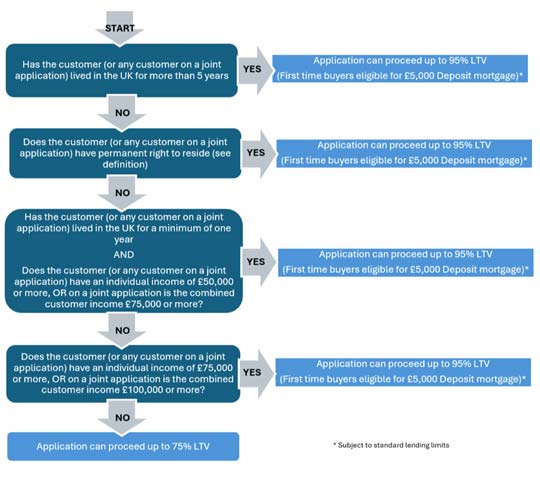
If a next step message shows ‘Proof of permanent right to reside in the UK is required for at least one applicant’ we can proceed with proof that the customer (or any customer on a joint application) has permanent right to reside, or proof that the customer (or any customer on a joint application) has lived in the UK for more than 5 years (or a minimum 1 year where they meet the minimum income requirement of individual £50,000 or more, or joint combined £75,000 or more).
Otherwise the loan to value would have to be reduced to 75% LTV to proceed.
Permanent right to reside can includeAs part of the EU Settlement Scheme EEA, EU and Swiss citizens, living in the UK by 31 December 2020 can apply to continue to live in the UK after 30 June 2021 and will receive one of two statuses which are both acceptable.
- Settled status - awarded where they have lived in UK for at least 5 years and also known as 'indefinite leave to remain under the EU Settlement Scheme'.
- Pre-settled status - awarded where lived in the UK for less than 5 years and they can re apply for settled status after 5 years continuous residence in UK has been reached.
- Indefinite leave to enter or remain.
- Republic of Ireland citizens do not need to apply under the EU Settlement Scheme and have automatic permanent right to reside in the UK. No proof of permanent right to reside is required for ROI citizens.
Proof of permanent right to reside could be verified to one of the following- An immigration status 'share code' - customers who can view their immigration status online at gov.uk can provide a share code which lasts for 30 days and we can use to view their immigration status, for example settled or pre-settled status.
- Only ‘immigration status’ share codes starting with an ‘S’ are acceptable and not ‘right to work’ or ‘right to rent’ share codes.
- Indefinite leave stamp in passport including Indefinite Right (or Leave) to Remain/Enter, Right of Abode, 'There is at present no time limit on the holder's stay in the United Kingdom’.
- Biometric Residence Permit showing 'indefinite' rights to remain (this includes 'indefinite leave to remain', 'indefinite leave to enter' or 'no time limit’).
- Letter from the Home Office confirming indefinite right to remain in the UK.
When an application meets the above criteria there is no requirement for the customer(s) to hold a particular type of visa or to have a minimum remaining visa validity.
‘Lived in the UK for more than 5 years’ means lived in the UK for at least the latest 5 years, but the customer may have spent periods aboard within the last 5 years. We will use data provided by the credit reference agencies to determine if a customer has lived in the UK for more than 5 years. Alternatively we can accept proof from the customer, for example a bank statement, HMRC tax notification, Local Authority Tax Bill or utility bill dated over 5 years ago.
‘Lived in the UK for a minimum 1 year’ – where the minimum income requirement of individual £50,000 or more, or joint combined £75,000 or more has been met - will also be confirmed using data provided by the credit reference agencies or we can accept proof from the customer, for example a bank statement, HMRC tax notification, Local Authority Tax Bill or utility bill dated over 1 year ago.
To calculate the income of £50,000, £75,000 or £100,000 we will include the total of all earned incomes or the latest year’s income for self employed customers.On Shared Equity and Shared Ownership schemes, to determine if the 0% to 75% loan to value (LTV) criteria has been met, the percentage LTV is calculated as the loan amount against the value of the customer's equity share. (On Shared Equity applications this differs to the LTV used for selecting from the product range which is the loan amount against the total purchase price).
Applications from non-UK nationals holding diplomatic immunity are not acceptable.
-
- Maximum of four applicants
- Two incomes are taken into account for affordability.
- For Bonus/Cash/Sale Of Mortgage Property repayment plans, only the income from the first two applicants will be used to determine the income qualifying criteria.
-
A customer can keep their existing Halifax mortgage property and buy a new main residence that is also mortgaged with Halifax, provided the:
- customer will live in the new property as their main residence
- existing Halifax-mortgaged property is retained as a second home
- existing property has a maximum LTV of 75%.
Where these conditions are met:
- the retained property can remain with Halifax as a second home mortgage
- customers can request consent to let during a fixed-rate deal if planning to rent the property
- the new main residence can be considered up to 90% LTV.
-
Product fees added to the loan
On new lending applications, any product fee added to the mortgage will be included in the total loan amount and must not exceed the maximum borrowing available based on affordability.
Impact on Loan to value
Adding a product fee to the mortgage will not affect the loan to value (LTV) band used for product selection.
If the customer's borrowing falls exactly on an LTV threshold, products within that LTV band remain available, even if adding the product fee takes the total borrowing above that LTV threshold.
Example:
- An application at exactly 75% LTV can select products within the 75% LTV range.
- If a product fee is added to the loan and the resulting borrowing exceeds 75% LTV, the customer can still access products within the 75% LTV range.
95% LTV exception
Product fees cannot be added to the mortgage where borrowing is at 95% LTV.
In these cases, the customer must either pay the product fee upfront or reduce the loan amount so the LTV remains within 95% when the fee is added.
-
Sub-sales and back-to-back transactions are not acceptable.
A sub-sale occurs when a property is bought and then sold on within six months, i.e. the borrower is buying the property from someone who has themselves bought the property less than six months before. The date of registration at the Land Registry is how we determine the length of ownership.
This means that the current vendor must have owned the property for at least six months before we can accept an application to purchase that property.
A back-to-back transaction is a type of sub-sale where the intervening seller buys from the original seller and sells on to the borrower on the same day or within a few days. We also regard as sub-sales, cases where the seller acquires the freehold (or superior leasehold) title to the property, which they then immediately sell on to the borrower by the grant to them of a lease (or sub-lease).
The following cases are exceptions where it is acceptable for the property to be sold on within six months of acquisition by the seller.
Where sales are by:
- A personal representative of the registered proprietor; or
- An institutional mortgagee exercising its power of sale; or
- A receiver, trustee-in-bankruptcy or liquidator; or
- A developer or builder selling a property acquired under a part-exchange scheme. If a company that is not a builder or developer has purchased a property and are now selling this on, this would be subject to the 6-month rule.
- A registered Housing Provider (Housing Association) exercising a power of sale.
We will also accept inherited properties where the applicant is a beneficiary but has not owned the property for 6 months. Applications where the applicant is not a beneficiary of the inherited property and the beneficiary has owned the property for less than 6 months are not acceptable and must be declined. The conveyancer will be responsible for ensuring the application meets the acceptable criteria.
Applications which involve assignable contracts or irrevocable powers of attorney in favour of intervening sellers are not acceptable. Any other structure to the transaction which has a similar effect should be reported to us.
-
A second charge (sometimes called a secured loan or second mortgage) is a loan secured against a property that already has an existing mortgage. The original mortgage lender holds the first charge and has first claim over the property. The second charge lender ranks behind the first charge lender. If the property is sold or repossessed, the first charge lender would be repaid before the second charge lender.
Halifax Policy
Halifax does not offer lending where our mortgage would rank as a second charge. All Halifax lending must be secured as a first charge against the property.
Where the customer's existing mortgage is with Halifax and they are applying for additional borrowing with us, any existing second charge lender must agree to postpone their charge so that all Halifax lending continues to rank ahead of the second charge lender.
Halifax will not lend as a second charge lender. Halifax lending must always hold first charge priority. Other lenders may hold a second charge behind Halifax.
-
You may submit an application for yourself or a family member. It is your responsibility to ensure that doing so meet the terms of your brokerage firm's compliance requirements and procedures.
-
Key Principles
Maximum Loan to Value (LTV)
- The maximum LTV for interest-only lending is 75%.
- For Sale of Mortgaged Property (SOMP) repayment plans, the maximum interest-only amount may be restricted by the minimum equity requirements.
- For part interest-only / part capital and interest repayment, lending is available up to 85% LTV, provided any lending above the interest-only limit is on a capital and interest repayment basis.
Credit Score Requirement
Customers must achieve a sufficient credit score with us to proceed.
Income Requirements
- The minimum sole or joint main earned income is £50,000.
- Certain repayment plans have additional income requirements. Where applicable, these are detailed within the relevant repayment plan section.
- Only basic salary, overtime, bonus, commission and latest years self-employed income can be used to meet the minimum income requirement across all repayment plans.
Maximum Age
- The mortgage term must not extend beyond the customer's 70th birthday.
- Some repayment plans may have additional retirement-related restrictions.
Repayment Plan Requirements
The customer must have an acceptable repayment plan in place for any:
- New borrowing
- Term reductions or extensions
- Transfer of mortgage property (TOMP)
The repayment plan must:
- Cover the full interest-only balance
- Be on our list of acceptable repayment plans
- Have a term that ensures sufficient funds will be available by the end of the mortgage term
- Be based on a UK or sterling-denominated asset or investment
- Be owned by one or more mortgage applicants who will occupy the mortgaged property
- Not rely on an asset or investment where a non-applicant has a legal or beneficial interest
Examples
- A parent who is named on the mortgage solely to support affordability, but will not occupy the property, cannot provide the repayment plan.
- A second property owned jointly with a brother, sister or any other person who is not a mortgage applicant cannot be used as a repayment plan.
Combining Repayment Plans
Customers can use more than one acceptable repayment plan to cover their interest-only balance.
However:
- Sale of Mortgaged Property (SOMP) cannot be combined with any other repayment plan.
The following repayment plans can be combined and used together to meet the minimum £50,000 repayment plan value requirement:
- Stocks and Shares ISAs
- Unit Trusts
- Investment Bonds
- Stocks and Shares
Evidence Requirements
- Evidence of the repayment plan must be provided before a mortgage offer can be issued.
- Use the interest only calculator to assess the maximum interest-only lending available under each repayment plan.
Acceptable Repayment Plans
The following repayment plans are acceptable:
- Bonus
- Cash Savings
- Endowment
- Pension
- Sale of Mortgaged Property (SOMP)
- Sale of Other Residential Property
- Stocks and Shares / Investments
Other than sale of mortgaged property customers may use more than one repayment plan to cover the total interest-only balance.
Bonus
Eligibility
The customer must meet one of the following income requirements:
- Sole income of at least £75,000.
- Joint income where one applicant earns at least £75,000.
- Combined joint income of at least £100,000.
Amount Available30% × the bonus figure × the mortgage term
The repayment plan value is calculated as:
The bonus figure is calculated in line with our standard bonus income assessment requirements. Where bonus is paid annually, this will be the average bonus received over the last 2 years.
Important
Where bonus is used as an interest-only repayment plan:
- Bonus income for any applicant cannot also be used within affordability.
- Customers are expected to make periodic lump sum reductions.
- Standard ERC rules apply where overpayment allowances are exceeded.
Evidence Requirements
Bonus Frequency
Evidence Required
Monthly
Latest 3 payslips
Quarterly
Latest 4 bonus payslips
Half Yearly
Latest 2 bonus payslips
Annually
Latest 2 years bonus payslips
Cash Savings
Eligibility
The customer must meet one of the following income requirements:
- Sole income of at least £75,000.
- Joint income where one applicant earns at least £75,000.
- Combined joint income of at least £100,000.
Repayment Plan Value
The customer must hold a minimum of £50,000 in cash savings for at least 3 consecutive months.
Savings can be held across multiple personal accounts. Where multiple accounts are used, the combined balance must have remained at or above £50,000 throughout the previous 3 months.
Up to 100% of the available savings balance can be used to support interest-only lending.
Where balances fluctuate during the previous 3 months, the lowest balance will be used when assessing the repayment plan value.
If the savings are also being used as the deposit, sufficient funds must remain to support both the deposit and the repayment plan.
NS&I Premium Bonds are treated as savings and can be used as a repayment plan.
Only personal savings accounts are acceptable. Business accounts cannot be used, even where the customer is the sole owner of the business.
Evidence Requirements
Customers can provide:
- A statement dated within the last month; and
- A previous statement showing the funds have been held for at least 3 consecutive months.
For NS&I Premium Bonds, an annual statement can be accepted as evidence.
Endowment
Eligibility
The customer must meet one of the following income requirements:
- Sole income of at least £50,000.
- Combined joint income of at least £50,000.
Repayment Plan Value
Up to 100% of the projected maturity value can be used.
The projected value is based on using the middle % or the lower projection if there are 2 growth rates.
Evidence Requirements
Provide:
- The latest endowment projection statement dated within the last 12 months.
- With profits Endowment current sum assured and total regular bonus statement dated within 12 months. We are unable to accept the surrender value or guaranteed minimum value.
Pension
Eligibility
The customer must meet one of the following income requirements:
- Sole income of at least £50,000.
- Combined joint income of at least £50,000.
Repayment Plan Value
Where a pension has a current or projected fund value of at least £400,000, up to 15% of the fund value can be used to support interest-only lending.
Where a pension provides a current or projected lump sum value, up to 60% of the lump sum value can be used instead.
Where both a fund value and lump sum value are provided, the lump sum value will be used.
The maximum repayment plan value that can be used is £160,965.
the repayment plan value will be capped at £160,965 where:
- 15% of the pension fund value exceeds £160,965 or
- 60% of the pension lump sum value exceeds £160,965
For pensions that do not show a current or projected fund value, such as final salary schemes:
- A minimum current or projected lump sum value of £100,000 is required.
- Up to 60% of the lump sum value can be used.
This limit reflects the current Lump Sum Allowance (LSA) of £268,275, which is the maximum tax-free lump sum available across an individual's pensions. The maximum repayment plan value is therefore restricted to 60% of this amount.
Where a statement provides projected values:
- Use the middle projection where three growth rates are shown.
- Use the lower projection where two growth rates are shown.
Pensions belonging to the same applicant can be combined to meet the minimum fund value or lump sum requirements.
Pensions belonging to different applicants cannot be combined.
Acceptable Pension Types
The following pension arrangements are acceptable:
- Personal pensions
- Occupational pensions
- Final salary pensions
- Self-Invested Personal Pensions (SIPPs)
Transfer value letters issued by a pension provider are also acceptable and will be treated as a current value. Up to 15% of the transfer value can be used where applicable.
Evidence Requirements
Provide the latest pension statement dated within the last 12 months.
Transfer value letters issued by the pension provider can also be accepted.
Important Points
Pension contributions must be keyed under Total Monthly Payment Towards Investment Vehicles and will be included within the affordability assessment.
Customers must understand the importance of maintaining pension contributions throughout the mortgage term.
If a customer has already taken a pension lump sum or is currently drawing an income from the pension, the pension can no longer be used as an acceptable repayment vehicle.
Where a lump sum has been withdrawn and transferred into another pension arrangement, the pension may still be acceptable subject to review by the Central Interest Only Team and evidence of the transfer being provided.
The interest-only term must not extend beyond the lower of the customer's Anticipated Retirement Age or Maximum Working Age of 70.
Sale of Mortgaged Property (SOMP)
Eligibility
The customer must meet one of the following income requirements:
- Sole income of at least £75,000.
- Joint income where one applicant earns at least £75,000.
- Combined joint income of at least £100,000.
Applications using this repayment plan are assessed against a higher credit score requirement than other acceptable repayment plans.
Repayment Plan Value
The available repayment plan value is based on the equity available within the mortgaged property.
The maximum interest-only LTV is 75%.
Equity Assessment
The equity available will be calculated using the valuation or property assessment completed as part of the application.
Any existing borrowing secured against the property, together with any new borrowing to be secured against the property, must be declared and will reduce the equity available.
For main residences, a minimum equity requirement applies:
Interest Only Amount
Minimum Equity Required
Up to 50%
£300,000
Over 50% to 60%
£500,000
Over 60% to 75%
£750,000
Use the interest only calculator to support any calculations.
Where part of the lending is on a repayment basis:
- The minimum equity requirement is assessed at the end of the mortgage term. Any capital and interest repayment lending can therefore be disregarded when calculating the minimum equity requirement.
- Part interest-only and part capital and interest repayment lending is available up to 85% LTV.
- The capital and interest repayment term cannot exceed the interest-only term.
For properties on the Second Home Scheme, the minimum equity requirement does not apply.
Important Points
- Any existing or proposed secured borrowing will reduce the equity available.
- The customer must understand that the property will need to be sold at the end of the mortgage term to repay the interest-only balance.
Sale of Other Residential Property
Eligibility
The customer must meet one of the following income requirements:
- Sole income of at least £50,000.
- Combined joint income of at least £50,000.
Repayment Plan Value
The property must:
- Be located within the UK.
- Have equity greater than £50,000.
- Be owned only by the mortgage applicant(s).
Up to 80% of the available equity can be used to support interest-only lending.
Each property used as a repayment plan must individually meet the minimum equity requirement.
Evidence Requirements
Provide:
- A completed Interest only - other residential property form.
- The latest mortgage statement where the lender is not part of Lloyds Banking Group.
Where the property has not yet been purchased, provide:
- Property details.
- Solicitor confirmation of ownership.
- Details of any borrowing to be secured against the property.
Important Points
- Ownership must match the mortgage applicant(s).
- We will assess the property's value using an Automated Valuation Model (AVM).
- If the property value exceeds £1,000,000, the Interest Only team will instruct a valuation through e.surv at no cost to the customer. The customer should be advised that access to the property may be required.
- Where an AVM is insufficient, the customer may obtain a RICS valuation at their own expense.
Stocks and Shares, ISAs and Investments
Eligibility
The customer must meet one of the following income requirements:
- Sole income of at least £50,000.
- Combined joint income of at least £50,000.
Repayment Plan Value
The investment must:
- Be UK based.
- Be held in sterling.
- Have a minimum value of £50,000.
Up to 80% of the current investment value can be used to support interest-only lending.
The following can be combined to meet the minimum £50,000 repayment plan value requirement:
- Stocks and Shares ISA
- Unit Trusts
- Investment Bonds
- Stocks and Shares
Acceptable Investments
- FTSE quoted Stocks and Shares
- Stocks and Shares ISAs
- Unit Trusts
- Open Ended Investment Companies (OEICs)
- Investment Bonds (UK)
Evidence Requirements
The customer will need to provide:
- Share certificates or
- Nominee account statements; or
- Confirmation from a recognised stockbroker showing holdings and valuations.
Where using an ISA, provide:
- The latest ISA statement dated within the last 12 months.
General Interest Only Rules
Unacceptable Repayment Plans
The following cannot be used:
- Sale of commercial property
- Sale of non-property assets
- Inheritance
Customer Responsibilities
Customers are responsible for ensuring their repayment plan remains on track.
We may request evidence of the repayment plan during the mortgage term.
If we are not satisfied that the plan remains sufficient, the customer may be required to convert some or all of the mortgage to capital and interest repayment.
Existing Halifax Customers Moving Home
Where an existing customer does not meet current interest-only policy, we may consider allowing interest-only lending up to the level already held, provided the mortgage term is not increasing.
The property tenure should be established before a full application is submitted, as it may affect whether the property is acceptable.
Where the customer is unsure of the tenure, they should check with the estate agent, solicitor, Land Registry or relevant property records.
Leasehold and Freehold
A leasehold property is owned for the remaining term of a lease. The freeholder owns the building and land, and ownership of the property returns to the freeholder when the lease expires.
A freehold property includes ownership of the building and the land on which it stands.
Flats are generally leasehold, although the customer may also own a share of the freehold or the freehold of the whole building. The applicable requirements depend on the ownership structure.
Leasehold Properties
Minimum Lease Term
A leasehold property is acceptable where at least 70 years remain on the lease at the date of application.
A property with fewer than 70 years remaining may be considered where the lease is being extended beyond 70 years as part of a:
- Purchase
- Remortgage
- Further Advance
The lease extension must complete on or before completion of the mortgage. A special condition will be added to the mortgage offer confirming that the offer is made on this basis.
Lease terms below 70 years that are not being extended are only acceptable on certain central London estates and are subject to separate criteria and worth discussing with us on a case-by-case basis.
Where the remaining lease term is only slightly above 70 years, the customer should be made aware that the property may be difficult to mortgage or sell in future unless the lease is extended.
Absent Landlords
Where a leasehold flat has an absent landlord and the lease needs to be extended, the application cannot proceed. This is because there may be no freeholder available to extend the lease or enforce the lease covenants.
Extending a Lease Beyond 70 Years
For an eligible purchase, remortgage or Further Advance:
- Key the full application using the current lease details.
- When instructing the valuation, add the following note to the valuers’ comments screen: “Lease extension to XXX years”.
- The valuer will record the present-condition value as £0 and provide the expected value based on the proposed extended lease.
- A final inspection will be arranged and the lending and LTV will be based on the improved valuation.
- The application will be referred to Underwriters so the relevant special condition can be added before the mortgage offer is issued.
Ground Rent, Service Charges and Factor Fees
Ground rent, service charges and Scottish factor fees that are or will be paid by the customer must be keyed as commitments and included in the affordability assessment.
Flats and Ownership Structures
Where the property is a flat, ownership arrangements can affect how the application is processed and how our mortgage is registered.
The following table sets out the requirements for each acceptable tenure structure.
Tenure Types and Requirements
The following requirements apply to flats and converted buildings. For converted buildings and purpose-built developments containing no more than four units, any lease should already be in place and must not be created as part of the mortgage application.
Tenure type
Requirements
Leasehold where the customer does not own the freehold or a share of the freehold
The Conveyancer will ensure the lease meets our standard requirements.
Leasehold where the customer owns, or will own on completion, the freehold of the whole building
Our charge must be registered against the freehold of the whole building and the leasehold interest of the unit. The mortgage, freehold title and leasehold title must be held in the same name. The freehold cannot be held by a Limited Company, family member or other third party. The customer may only own one unit within the building. The Conveyancer will ensure the lease meets our standard requirements.
Leasehold where the customer owns, or will own on completion, a share of the freehold of the whole building
Our charge must be registered against the leasehold interest only. The customer may only own one unit within the building. The Conveyancer will ensure the lease meets our standard requirements.
Freehold flat where the other flats in the building are leasehold
The customer must personally own the whole freehold in their own name. The mortgage and freehold title must be held in the same name. The freehold cannot be held by a Limited Company, family member or other third party. All other units must be subject to leases with at least 70 years remaining. The customer may only own one unit within the building. Our charge will be registered against the freehold and the application will be processed as a freehold house.
If each flat within the building is separately registered as freehold, the property is not acceptable and the application must be declined.
Development containing more than four units
The tenure must be leasehold and a management company must be in place. The customer may hold a share in the management company. The Conveyancer will confirm that the management arrangements are acceptable. Our mortgage must be registered against the leasehold title.
Freehold Reversion Leases
Freehold Reversion leases are also known as:
- Tyneside leases
- Cross-Referred leases
- Mirror leases
These arrangements should be keyed as Leasehold Flats.
Underleases
An underlease is acceptable security.
Apply the same requirements as for a lease created directly from the freehold. The underlease must meet our standard leasehold requirements and the applicable requirements in the UK Finance Mortgage Lenders’ Handbook.
Flying Freeholds
A flying freehold exists where part of a property extends over another property or another person’s land.
Flying freeholds are generally not acceptable. However, consideration may be given where only a limited part of the property is affected, for example where one room partly extends over the adjoining property.
The valuer will confirm whether the individual property is acceptable within the Property Risk Assessment report.
Commonhold Properties
Commonhold properties are not acceptable.
Under commonhold ownership, the customer owns the freehold of the individual property, while a Commonhold Association owns and manages the common parts of the building.
Scotland
All Scottish properties, including flats, should be keyed as Ownership Interest.
In the Property screen:
- Key the anticipated completion date as the Entry Date (Scotland).
- Only enter an amount under Annual Chief Rent or Feu Duty where a payment applies.
- Leave the field blank where no payment applies.
Northern Ireland
Flats in Northern Ireland are generally leasehold.
Fee Farm Grants may also be encountered. These are historic arrangements with elements of both freehold and leasehold tenure. New Fee Farm Grants could not be created after 1997, and the leasehold element may be bought out.
Conveyancer Requirements
The Conveyancer is responsible for confirming that:
- The lease meets our standard requirements.
- The titles and ownership arrangements meet our requirements.
- Any management company arrangements are acceptable.
- Our mortgage is registered against the correct title or titles.
Applications from customers with a minimum one year's self-employed trading history are not automatically accepted but will be individually assessed by an underwriter. A member of our underwriting team will consider the income earned before becoming self-employed, previous experience in the same industry will be considered where applicable, income evidenced during the first year of trading and projected future income.
The following evidence may be requested to support the assessment, where applicable:
- A covering note outlining the applicant's line of work, how long they have worked in the industry and their experience before becoming self-employed.
- Evidence of previous income, such as P60s from before becoming self-employed
- A full 12 months' trading history, evidenced by a Tax Calculation (SA302) or finalised company accounts (finalised profit and loss account for a sole trader)
- A projection letter from the accountant, addressed to Halifax or the customer. Including details of how the projection has been calculated, such as contracts in place, invoices issued and income already received
- The latest 3 months' business and personal bank statements
- Where possible, the projection and supporting bank statements should cover a period after the first trading year has ended. This helps demonstrate that income levels are continuing beyond the period already within the accounts
Giving as much supporting evidence as possible upfront helps demonstrate that future income is likely to continue and gives the application the best opportunity of being approved. The underwriter will consider the application as a whole, not just the income but also the overall risk profile and loan to value (LTV).
A change of status for example a sole trader to limited company does not reset the timeframe for assessment. So, the original start date is entered and not the date the company changed status.
-
Key Principles
We use affordability to determine the maximum loan available.
- If the loan requested exceeds the maximum loan available from our affordability assessment, the loan amount must be reduced or the application cannot proceed.
- Our affordability calculator provides an indication of the maximum loan available.
- No credit search is carried out when using the affordability calculator, so the result may change once a Decision in Principle (DIP) is completed.
- Loan to Income (LTI) caps apply in addition to affordability.
- LTI caps are maximum limits only. The maximum loan available may be lower once affordability, credit score, credit profile, loan to value (LTV) and product criteria have been assessed.
Refer to our Affordability Calculator for an indication of the maximum loan available.
Standard Loan to Income (LTI) Caps
LTI caps Income
LTV
Loans ≤ £750,000
Loans > £750,000
Income
Less than £40,000
LTV
0 - 95%
Loans ≤ £750,000
4.49x
Loans > £750,000
N/A
Income
£40,000 - less than £50,000
LTV
0 - 85%
85.01% - 95%Loans ≤ £750,000
4.75x
4.49xLoans > £750,000
N/A
N/AIncome
£50,000 - £75,000
LTV
0 - 75%
75.01 - 85%
85.01 - 95%Loans ≤ £750,000
5.00x
5.00x
4.49xLoans > £750,000
N/A
N/A
N/AIncome
More than £75,000 - £125,000
LTV
0 - 75%
75.01 - 85%
85.01 - 90%
90.01 - 95%Loans ≤ £750,000
5.50x
5.00x
4.75x(loan ≤ £500,000)
4.49x (loan > £500,000 and ≤ £750,000)4.49x
Loans > £750,000
5.50x
5.00x
N/A
N/AN/A
Income
More than £125,000
LTV
0 - 85%
85.01% - 90%
90.01 - 95%Loans ≤ £750,000
5.50x
4.75x (loan ≤ £500,000)
4.49x (loan >£500,000 and ≤ £750,000)
4.49xLoans > £750,000
5.50x
N/A
N/AFirst-Time Buyer Boost
Eligible applications may qualify for an LTI of up to 5.50x income.
First-Time Buyer Boost LTI
First_Time Buyer Boost LTI Income
LTV
LTI
Income
£40,000+
LTV
0% - 90%
LTI
5.50x
Income
£40,000+
LTV
90.01% - 95%
LTI
4.49x
Eligibility
- Purchase applications only.
- At least one applicant must be a first-time buyer.
- Total application income must be £40,000 or more.
- Maximum 90% LTV.
- Not available on Shared Equity or Shared Ownership schemes.
Important Points
- Some applications may be restricted to a maximum LTI of 5.00x due to the overall credit profile.
- In some cases, the credit score achieved may result in standard LTIs being applied instead.
£5,000 Deposit Mortgage
LTV
LTI
LTV
Greater than 95%
LTI
4.49x
Additional LTI Rules
Affordable Housing Schemes
For Shared Equity and Shared Ownership applications, the maximum LTI is 4.49x.
Self-Employed Applicants
There are no separate LTI caps for self-employed applicants. Standard LTIs apply.
Like for Like Remortgages
For like for like remortgages, an enhanced LTI of up to 5.50x may be available where the standard LTI would otherwise be lower, subject to:
- No additional borrowing.
- A maximum LTV of 75%.
- Credit score.
For Shared Equity and Shared Ownership remortgages, the maximum LTI remains 4.49x.
Credit Score and Credit Profile
The maximum LTI available may be reduced based on the credit score achieved and overall credit profile.
Depending on the application, the maximum LTI may be restricted to:
- 5.00x instead of 5.50x.
- 4.49x instead of a higher standard LTI.
- 4.00x where income exceeds £75,000, the loan exceeds £500,000 and a reduced LTI is applied.
Product-Specific Restrictions
A different maximum LTI may apply depending on the product selected.
Affordability Adjustments
When assessing affordability we may:
- Use the property's EPC rating to reflect estimated energy costs.
- Apply a deduction for future financial planning commitments.
- Apply an affordability adjustment for some contractors to reflect likely business expenses.
- Continue to include some credit commitments even where the customer intends to repay them.
If these adjustments reduce the maximum loan available, the loan amount must be reduced to proceed.
EPC Ratings and Affordability
A property's Energy Performance Certificate (EPC) rating is used within our affordability assessment.
- Properties with an EPC rating of A or B may benefit from a small increase in the maximum loan available.
- Properties with an EPC rating of F or G may see a small decrease in the maximum loan available.
- There is no change to the maximum loan available where the property has an EPC rating of C, D or E, or where the EPC is unknown.
Interest Only Applications
For interest only lending, affordability includes the cost of the repayment vehicle.
Where applicable, details of any repayment vehicle premiums must be entered at both DIP and full application stage.
Future Changes to Income and Expenditure
Our affordability assessment takes account of future changes to income and expenditure where applicable.
Where the Maximum Loan Available is Lower Than Requested
If the maximum loan available is lower than the amount requested:
- The loan amount must normally be reduced.
- It may be possible to extend the mortgage term, subject to policy. This may include lending into retirement where the relevant evidence and retirement income requirements are met.
- If income cannot be evidenced at the declared level, the loan amount must be reduced accordingly.
Before reducing the loan amount, check that the application has been keyed correctly and that all credit commitments match the latest credit bureau information. Differences between the information keyed and the credit bureau may affect the maximum lending available.
Exceptions
We may only consider lending above the maximum loan available from our affordability assessment where:
- The customer is an existing Halifax mortgage customer and there is no increase in loan amount or loan to value (LTV) compared with their current mortgage.
- Additional income is available, can be evidenced in line with policy requirements, and is expected to continue for the life of the mortgage.
-
Accuracy of Keying
All commitments must be keyed accurately to ensure a correct affordability assessment.
Advisers must:
- Ensure they are familiar with the commitment types that must be keyed and how each commitment is treated.
- Discuss all commitments and outgoings with the customer.
- Include any commitments recorded with a credit reference agency, including mobile phone contracts.
- Only select 'None' where the customer has no commitments.
Advisers should consider asking the customer to provide a copy of their credit report to help identify all commitments.
Business Commitments and Personal Guarantees
Commitments held in the name of a Limited Company owned by the customer do not need to be keyed, as they are the responsibility of the Limited Company rather than the customer.
Personal guarantees provided for mortgages or loans to family members or friends must be keyed as a commitment, as these are separate from the customer's business interests.
For guidance on commitments where a self-employed customer has personal liability, or where a Company Director has provided a personal guarantee, please refer to the Self-Employed Business Commitments section.
Commitments to be Repaid on or Before Completion
Commitments that will be repaid on or before completion must still be keyed.
Select 'Yes' for 'Intend to Repay on Completion'.
This includes the existing mortgage on a remortgage application.
Selecting 'Intend to Repay on Completion'
Only select 'Yes' where:
- The customer confirms they intend to repay the commitment on or before completion.
- The proposed repayment appears reasonable given the remaining balance and term of the commitment.
- You are satisfied the customer has sufficient means to repay the commitment, for example from savings or regular income.
Commitments Marked as Being Repaid
Where commitments are marked as being repaid, the mortgage offer will include a condition confirming that:
- The affordability assessment has been based on the customer's declared intention to repay the commitment.
- The commitment must be repaid on or before completion.
Recently Repaid Commitments
If a commitment has recently been repaid but may still appear on information held by a credit reference agency, the commitment must still be keyed and marked as 'Yes' for 'Intend to Repay on Completion'.
Partial Repayment of a Commitment
Where only part of a commitment will be repaid:
- Key one commitment as being repaid in full.
- Key a second commitment with the remaining balance.
- This tells the system how it will look from completion onwards.
Loans Above 85% LTV
For all loans above 85% loan to value (LTV), and any other applications where we consider it prudent, commitments may still be treated as ongoing within the affordability assessment, even where the customer has declared an intention to repay them on or before completion.
The loan amount must remain affordable on this basis.
Payslips
Check whether a customer's payslips include deductions that should be keyed as commitments.
Examples include:
- Student loans
- Childcare vouchers
- Salary sacrifice loan schemes, such as vehicle finance
Payslip Deductions That Do Not Need to Be Keyed
The following financial payslip commitments do not need to be keyed:
- Beneficial loans provided by an employer solely for a travel season ticket or Cycle to Work scheme.
- Employer savings schemes (for example, Sharesave), provided the customer could stop the contributions if required.
- Additional pension contributions provided the customer could stop the contributions if required.
Keying hints
- Where a commitment does not have a definitive end date, enter a reasonable estimated end date.
- For commitments with a monthly payment but no total outstanding balance, enter the balance as an annual amount (12 × monthly payment).
- Where a property is owned jointly with someone who is not named on the application, key the full monthly mortgage payment, not just the customer's share.
- For the definition of child and adult financial dependants, see the Dependants section.
- For guidance on answering adverse credit application questions, please see Adverse Credit.
Commitment types to be keyed:
Loans
Loans Commitment type
Notes
Commitment type
Hire purchase
Notes
- Include any car lease or Personal Contract Purchase (PCPs)
Commitment type
Loan
Notes
- Include any secured or unsecured loans
- Include as a loan any monthly payment to a Debt Management Plan/IVA
Commitment type
Buy now pay later
Notes
- Include any deferred payment credit (DPC) e.g. pay in 3 or 4 payments as well as longer term buy now pay later options
- If the customer is still in the payment free period key what the monthly payment will be once these commence
Commitment type
Interest free loan
Notes
- Include any retailer loans e.g. furniture
Commitment type
Student loan
Notes
- If a customer advises that they have not yet started making any payments this does not need to be included, but if they are or are about to start payments, then this should be keyed
- Please check if a customer’s payslips show a student loan is being repaid and should be keyed as a commitment
- When a student loan commitment is keyed it will be deducted in our affordability calculation, even if it is selected as being repaid upon completion
Cards & other credit
Cards & other credit Commitment type
Notes
Commitment type
Credit card
Notes
- Key the current outstanding balance and monthly payment being made by the customer
- 5% of the outstanding balance is taken as a monthly commitment even if the customer declares that they are currently making a lower payment
- If your customer clears their balance in full each month, key the monthly payment to be the same as the outstanding balance and select ‘No’ for ‘Intend to Repay on Completion’
- Include any store cards
Commitment type
Charge card
Notes
- (See under Credit card)
Commitment type
Overdraft
Notes
- Key the current outstanding balance and monthly payment being made by the customer
- 5% of the outstanding balance is taken as a monthly commitment even if the customer declares that they are currently making a lower payment
- If your customer clears their balance in full each month, key the monthly payment to be the same as the outstanding balance and select ‘No’ for ‘Intend to Repay on Completion’
Commitment type
Mail order
Notes
- Key the monthly payment and balance as confirmed by the customer
Family
Family Commitment type
Notes
Commitment type
Child care
Notes
- Include any nursery costs, childminder costs, child care vouchers and before/after school clubs
- Please check if a customer’s payslips show child care vouchers which should be keyed as a commitment
Commitment type
Maintenance
Notes
- Include any payments for an ex-partner or dependent children who are not living with the customer
Commitment type
School fees
Notes
- Key the monthly fees amount as confirmed by the customer
Property
Property Commitment type
Notes
Commitment type
Mortgage
Notes
- On Remortgages the existing mortgage to be replaced with our mortgage must be keyed as a commitment with ‘Yes’ for ‘Intend to Repay’; under source of funds select other and type ‘this mortgage’
- A mortgage ‘type’ must be completed for any mortgage commitment which will usually be either ‘Residential’, or ‘Buy to Let’ if the property is already let or is to be let
- For any Buy to Let (BTL) mortgages please also key the rental income received under ‘Other income’ in the customer’s income section. If the gross rental income received is below 125% of the BTL mortgage payments the shortfall will automatically be deducted as a commitment in our affordability assessment
- If an existing residential mortgage is being remortgaged/converted to a BTL then key a residential mortgage as being repaid and a new BTL mortgage commitment as to remain with the new balance/payment that will apply upon completion
- For any other ‘residential’ mortgaged properties to remain in the background an assumed running cost will be deducted within the affordability assessment
Commitment type
Ground rent
Notes
- If purchasing a leasehold property you must tick ‘Yes’ to ‘Do you intend to purchase a flat?’
- Under Commitment type you will then be able to key the service charge and/or ground rent amounts
- Key £1 if no fee applies
- At Decision in Principle stage if the commitments have not been keyed, as not known, we will use an assumed value for these in our affordability calculation, which may mean that at Full Application when the true details are keyed under the property details page, this could affect the loan amount we are willing to lend
- When a full application is keyed and the service charge/ground rent keyed under the property details, we will use the higher of the value from the commitments screen or property details screen, so there is no need to amend/delete the details keyed under the credit commitments as they will not be counted twice
Commitment type
Service charge
Notes
- (See under Ground rent)
Commitment type
Second home
Notes
- Should be selected if an unencumbered residential property will remain in the background
- Key £1 as running cost and a standard deduction for these costs will be included in our affordability calculation
Commitment type
Rental
Notes
- If the customer has any rental agreements in their name for another property which will continue e.g. a pied-e-terre
Other
Other Commitment type
Notes
Commitment type
Other regular committed expenditure
Notes
- For any other regular committed expenditure which the customer could not, or would not want to stop, and it doesn’t fit into any category
- Anything keyed as ‘other’ will be deducted in our affordability calculation, even if it is selected as being repaid on completion
-
Who is a Contractor?
A customer is considered a contractor where their income is derived from a contract rather than permanent employment.
Examples include:
- Self-employed contractors who pay their own tax
- Contractors employed through an umbrella company
- Fixed-term or short-term contract workers
- Agency workers
Treating a Contractor as Self-Employed
A contractor should be treated as self-employed where:
- They pay their own tax or
- They have more than one contract and income from more than one contract is required for affordability or
- They operate through a Limited Company and employ other contractors.
Income must be evidenced using the standard self-employed income requirements.
Treating a Contractor as Employed
A contractor can be treated as employed where:
- Tax is deducted by the company they work for, or
- Tax is deducted by an umbrella company, or
- They pay their own tax or class themselves as self-employed and earn more than £500 per day, or
- They pay their own tax or class themselves as self-employed and earn more than £75,000 per annum, calculated over a 46-week year.
IT Contractors
An IT contractor can be treated as employed regardless of income level, even where they pay their own tax or consider themselves self-employed.
Exceptions
An IT contractor must be treated as self-employed where:
- They have more than one contract and income from more than one contract is required for affordability or
- They operate through a Limited Company and employ other contractors.
Continuous Employment Requirements
To be treated as employed, the customer must have either:
- At least 12 months' continuous employment, with a minimum of 6 months remaining on their current contract; or
- At least 2 years' continuous service in the same type of employment.
Are gaps in employment allowed for contractors?
Gaps between contracts do not automatically prevent an application from proceeding.
When assessing income sustainability, consider:
- The reason for the gap
- The duration of the gap
- The customer's previous experience in the same field
Example:
A four-week gap due to holiday or sickness would normally be considered reasonable.
Contractor Income Assessment
Contractors Who Pay Their Own Tax or Are Paid Through an Umbrella Company (Including IR35)
Evidence Requirements
Provide:
- A copy of the latest contract; and
- The latest month's payslip(s)
Where payslips are not issued, normally where applicants invoice, then please provide a copy of the latest bank statement showing the income received.
Income Calculation
Use the lower of:
- The gross value of the contract; or
- The income calculated from payslips or bank statements.
Gross Contract Value
Calculate contract income using:
Daily rate × 5 days × 46 weeks
or
Hourly rate × 7 hours × 5 days × 46 weeks
Where the contract specifies lower hours, days or weeks, use the contracted figures instead.
Payslip or Bank Statement Income
Annualise the gross income received and calculate it using a 46-week year.
Examples:
- Monthly gross pay × 12 ÷ 52 × 46
- Average gross weekly pay × 46
Keying Income
The lower of the two calculated figures must be keyed and used within the affordability assessment.
Umbrella Company Payslips
Umbrella company payslips may split income into several elements, including:
- Basic salary
- Commission
- Additional taxable income
- Holiday pay
Where the contract confirms payment via a daily or hourly rate, the income can be keyed as basic salary and does not need to be split into separate income types.
Limited Companies and LLPs
Where a contractor operates through a Limited Company or Limited Liability Partnership (LLP), the income evidence must be provided by the contracting employer and not the customer's own business.
Multiple Shareholders
Where a contractor operates through a Limited Company:
- If another shareholder is also named on the mortgage application, the contract income must only be keyed once.
- No additional income from the same contract can be keyed for the other shareholder/customer (s).
- If another shareholder is not named on the mortgage application, only the customer's share of the income can be used.
Example:
A customer with a 50% shareholding can use 50% of the contract income.
Fixed-Term, Short-Term and Agency Workers
Evidence Requirements
Provide:
- The latest month's payslip(s); or
- The latest 3 months' payslips where income varies or additional income is being used.
Income Calculation
Annualise the gross income received and calculate it using a 46-week year.
Example:
Monthly gross pay × 12 ÷ 52 × 46
Construction Industry Scheme (CIS) Contractors
Treating CIS Contractors as Employed
CIS contractors are generally treated as employed where tax is deducted at source.
Treating CIS Contractors as Self-Employed
A CIS contractor should be treated as self-employed where:
- They are responsible for all of their own tax, usually 20% is deducted at source or
- They have contracts with more than one company and income from both contracts is required for affordability.
Evidence Requirements
Provide:
- The latest 3 consecutive months' income evidence; and
- Matching bank statements.
Acceptable income evidence includes:
- Payslips
- Invoices
- Statements
Income evidence may be from the same or different contracts where the customer has recently changed employer.
The evidence must be issued by the company the customer works for and must not be self-billed.
Income Calculation
Calculate income using the average of the latest 3 months and annualise it using a 46-week year.
Payment periods with no income, or where supporting evidence cannot be provided, should be included in the calculation as £0.
Income Calculator
The Guide to keying employed income calculator can be used to support the calculation.
Junior and Locum Doctors
Income should be evidenced using payslips covering the latest 12 weeks and annualised using a 46-week year.
Applications can proceed where:
- At least 6 months' continuous employment can be established; and
- Confirmation of a remaining or future contract can be obtained.
Where confirmation of a future contract is unavailable, the application may still proceed where the standard contractor criteria can be met.
Associate Dentists
Associate Dentists are normally employed within NHS dental practices and paid according to units of dental activity (UDAs).
Income should be based on the actual attainable income after contractual deductions.
Example
- UDA contract value = £94,000
- NHS contract deduction = 50%
The customer's attainable income is £47,000.
This figure should then be annualised using a 46-week year £47,000 / 52 x 46 = £41,577) before being keyed.
Probationary Employment
Income can only be used where the probationary period forms part of a permanent employment contract.
Permanent Contract with Probationary Period
Where a customer has accepted a permanent role that includes a probationary period:
- Key the employment as Permanent.
- The income can be used within the affordability assessment.
Professional Sports People
Applications from Professional Sports People may be considered where either:
- At least 12 months' continuous employment can be established with a minimum of 6 months remaining on the contract; or
- At least 2 years' continuous service in the same type of employment can be established.
Careful consideration should be given to the customer's ability to maintain mortgage repayments as they approach the end of their career or if their career ends unexpectedly due to injury.
Unacceptable contracts
The following contract types are unacceptable and the income cannot be used for affordability purposes:
Probationary contracts
- Where the employer has the option to offer permanent employment at a later date.
Other unacceptable contract types
- Piecework
- Price work
- Seasonal contracts
- Temporary contracts
-
Treat as self-employed
If any of the following applies, a customer must be treated as self-employed:
- They own 25% or more of the business.
- They receive dividends or a share of the business's net profits as part of their income.
- Joint applicants with a combined 25% shareholding must both be treated as self-employed
Treat as employed
A customer can be treated as employed if they:
- own less than 25% of the business
- don’t receive dividends or a share of the business's net profits as part of their income.
In these cases, bank statements must be provided to support the payslips used for income verification.
Additional income verification requirements
Where a customer is paid by faster payment, an employment history document from HMRC is required to verify the income shown on the payslips and bank statements.
The employment history document can be:
- issued by HMRC by post
- downloaded from the HMRC website or the HMRC app.
-
Acceptable Applications
Non-sterling income can be used on all applications.
For Further Advances and Product Transfers, non-sterling income can be used even where it was not included on the original application.
There is no minimum income requirement for non-sterling income. However, applications assessed under our Seafarers criteria are subject to separate income requirements. Please refer to the Seafarers section for details.
Acceptable Currencies
We currently accept income in the following currencies:
- US Dollar (USD)
- Euro (EUR)
- Australian Dollar (AUD)
- Indian Rupee (INR)
- Swiss Franc (CHF)
Only one non-sterling currency can be used on an application.
Sterling income and non-sterling income can be used together on the same application.
Acceptable Income Types
The following employed income types can be accepted in a non-sterling currency:
- Basic salary
- Bonus
- Overtime
- Commission
Non-sterling income cannot be used for any other income types.
Self-Employed Income
Non-sterling self-employed income is not acceptable.
The only exception is a partner of a Limited Liability Partnership (LLP), where the income is verified by a letter from the Finance Director.
Currency Conversion and Haircuts
Income must be keyed in the original currency and not as a GBP equivalent.
A currency dropdown field should be used when keying income.
Within the application system we will:
- Convert the income to GBP
- Apply a 20% haircut to basic income
- Apply a 10% haircut to bonus income
These reductions are applied to account for potential exchange rate fluctuations.
Exchange Rates
Our Mortgage Affordability Calculator uses current exchange rates.
When an application is submitted, the exchange rate used at Decision in Principle (DIP) stage will remain fixed for that application.
The maximum loan available will therefore not change due to future exchange rate movements.
Income Verification
Payslips
Where payslips show income in the original non-sterling currency, no additional evidence is required.
Where payslips only show the converted GBP amount, a Compensation Letter or Remuneration Statement must also be provided.
Invoices aren’t acceptable in lieu of payslips because they are not prepared by the employer.
Compensation Letter / Remuneration Statement Requirements
The document must show:
- Employer name
- Employee name
- Pay date
- Currency being paid
- Income type (for example salary or bonus)
The document must be:
- Issued directly by the employer
- Provided through the employer's online systems
Language Requirements
All payslips and supporting documents must be provided in English by the employer. Translated versions of the payslip, even if done by a professional are not acceptable.
UK Residency Requirements
All mortgage applicants must be UK residents.
This means the customer must have their primary address in the UK.
A correspondence address or a family member's address cannot be declared as a primary address where the customer lives outside the UK.
Primary Address
A customer may spend most of their time overseas but still have a primary address in the UK.
UK residency for mortgage purposes is not the same as tax residency.
There is no requirement for customers to be UK tax residents.
Definition of Non-Sterling Income
Non-sterling income is any income originally paid in a currency other than Pound Sterling.
This remains non-sterling income even where it is converted into GBP before being paid into a bank account.
The following are treated as Pound Sterling and are not considered non-sterling income:
- Jersey
- Guernsey
- Isle of Man
- Gibraltar
- Falkland Islands
Mortgage Documentation
Where non-sterling income is used:
- Additional wording will appear within the Mortgage Illustration.
- Customers will receive a post-completion letter if exchange rate movements reduce the value of the income by more than 20%.
Contractors with Non-Sterling Income
To use non-sterling income, a contractor must meet our standard employed contractor requirements.
Where contractor income is assessed against the £500 per day or £75,000 per annum thresholds, the equivalent non-sterling amounts are:
Contractors with Non-Sterling Income Currency
Daily Rate
Annual Income
Currency
Swiss Franc (CHF)
Daily Rate
600
Annual Income
84,000
Currency
Euro (EUR)
Daily Rate
600
Annual Income
90,000
Currency
US Dollar (USD)
Daily Rate
600
Annual Income
95,000
Currency
Australian Dollar (AUD)
Daily Rate
1,000
Annual Income
150,000
Currency
Indian Rupee (INR)
Daily Rate
55,000
Annual Income
8 million
Evidence Requirements
The customer will need to provide a copy of them
- Contract and
- Bank statements or payslips showing income received.
Where bank statements only show the converted GBP amount, payslips or a Compensation Letter / Remuneration Statement must also be provided showing the original currency amount.
Self-Employed Customers with Overseas Income
Where a business is not UK-based, self-employed income cannot be used.
Where a business is UK-based:
- Standard self-employed verification requirements apply.
- Sterling income evidenced through SA302s and Tax Year Overviews can be used.
- Any amount shown as "Foreign Income" on an SA302 must not be included.
Bonuses Paid in Different Currencies
Where bonus income has been received in different currencies over the last two years:
- Only the latest year's bonus can be used.
- The currency selected should be the currency of the latest bonus payment.
- The two-year average should be calculated using:
- Latest year's bonus amount and
- £0 for the previous year.
Frequently Asked Questions
Can non sterling income be accepted for seafarer contractors?
Yes. Please see seafarers’ criteria for full details.
Does income have to be paid into a UK bank account?
No. There is no requirement for income to be paid into a UK bank account.
The customer must still meet the UK residency requirements.
Do payslips need to show UK tax?
No. Payslips may show:
- UK tax
- Foreign tax
- No tax deductions
The customer must still meet the UK residency requirements.
-
Payslips
Payslips must show:
- Customer name
- Employer name
- Pay date
- Basic income
- Gross pay
- Net pay
- Any additional income being used within the affordability assessment
Handwritten Payslips
Are Handwritten payslips acceptable? Yes.
Handwritten payslips are acceptable where corresponding bank statements are provided showing the income paid by the employer.
Bank Statements
Bank Statement Requirements
Bank statements must show:
- Customer's full name, or initial and surname
- Account number
Internet Bank Statements
Internet bank statements must also show:
- Bank name or bank heading
- Web address
Benefit Award Letters
Benefit Award Letters must:
- Be dated within the last 12 months
- Show the customer's name
- Show the value of the benefit being received
Benefits received on behalf of another person, such as a dependant, cannot be used.
Employer References
Where required, employer contact details must be provided so we can request a reference directly from the employer.
The employer reference must:
- Be returned directly to us
- Be addressed to Halifax
- Be signed and dated
- Be completed by a named individual whose position is provided
- Have any amendments clearly marked and initialled
What format can the employer use?
The employer can either:
- Complete our employer reference form and provide company headed paper
- Provide the required information in their own format
What information must the reference include?
The reference must include:
- Employer name and address
- Employee name, address and contact number
- Employment start date and job title
- Contract status
- Income details, including basic salary and any additional income
- Mortgage application number
Send completed references to employmentreference@lloydsbanking.com
Fixed Income
Where basic income is the same each month, fortnight or week, only the latest income
months evidence is required:
- Monthly paid: 1 payslip
- Fortnightly paid: 2 payslips
- Weekly paid: 4 payslips
Variable Income
The latest 3 months' income evidence is required where:
- basic income varies or
- variable income is being used within the affordability assessment.
Examples include:
- 3 monthly payslips
- 6 fortnightly payslips
- 12 weekly payslips
If one or more pay periods show no income, for example a week with £0 income. These periods can still be included within the averaging calculation where you are satisfied that the reason for the reduction is reasonable and the income remains sustainable.
Before using this income, you must be satisfied that the variation is plausible and the income remains sustainable.
An average should be used when assessing the income.
A note must be added to explain the variation, for example:
The customer's basic pay varies due to the nature of their employment. Therefore, I am satisfied that the income remains sustainable.
Bonus and Commission Income
Calculating Bonus and Commission Income
For bonus or commission income paid less frequently than monthly, for example:
- Yearly
- Half yearly
- Quarterly
key the lower of:
- total income received during the last 12 months or
- the average income received over the last 2 years
All payslips showing this income for the latest 2 years are required.
Overtime, Bonus and Commission
For overtime, bonus or commission paid monthly, 4-weekly, fortnightly or weekly, provide payslips covering the latest 12 weeks.
For customers paid monthly, provide the latest 3 consecutive payslips.
Bonus or Commission received from previous employer
commission and non-annual bonuses
- Only income received from the current employer can be used.
- If commission or non-annual bonus income received in the previous year was from a previous employer, use £0 for that year when calculating the 2-year average.
Annual bonuses
An annual bonus received from a previous employer may be included where:
- The latest annual bonus was paid by the current employer and
- The customer remains in the same line of work.
Missing Bonus Payments
Where bonus income was not received during one or more periods, or supporting payslips are unavailable, use £0 for the missing period when calculating the income.
Examples include:
- A recent change of employment
- No bonus being paid in a particular year
- Missing payslip evidence for a bonus payment period
This applies only where you are satisfied that the income remains sustainable.
Bonus Paid in Shares
Bonus income paid in shares can only be used where there is evidence that the shares were immediately cashed in.
Income Type
Acceptable?
Main or
OtherKey As
Evidence
Income Type
Additional Duty Hours (including Additional
Responsibility Hours)Acceptable?
Yes
Main orOther
Other
Key As
Additional Duty Hours
Evidence
Latest 3 months payslips
Income Type
Adoption Allowance
Acceptable?
No
Main orOther
Key As
Evidence
Income Type
Airbnb
Acceptable?
No
Main orOther
Key As
Evidence
Income Type
Area Allowance
Acceptable?
Yes
Main orOther
Other
Key As
Town / Area / Car
AllowanceEvidence
Latest months payslip(s)
Income Type
AFC Absence
Acceptable?
Yes
Main orOther
Other
Key As
Additional Duty Hours
Evidence
Latest 3 months payslips
Income Type
Armed Forces Independence Payments
(AFIP)Acceptable?
Yes
Main orOther
Other
Key As
Pension - Private
Evidence
Latest Bank Statement (where paid gross) or Latest Pension
Statement / Payslip or Pension P60Income Type
Attendance Allowance
(State Benefit)Acceptable?
Yes
Main orOther
Other
Key As
Attendance Allowance
Evidence
Latest Bank Statement or
Benefit Award LetterIncome Type
Attendance Allowance
(Turning Up To Work)Acceptable?
No
Main orOther
Key As
Evidence
Income Type
Bank Holiday Pay (only if it forms part of basic pay and doesn't inflate income)
Acceptable?
Yes
Main orOther
Main
Key As
Basic Annual Income
Evidence
Latest months payslip(s)
Income Type
Basic Salary (including the probationary period of a permanent contract)
Acceptable?
Yes
Main orOther
Main
Key As
Basic Annual Income
Evidence
Latest months payslip(s)
Income from a new permanent job can be used immediatelyIncome Type
Bereavement Allowance (previously Widows Pension. If State Widows Pension, please see below).
Acceptable?
No
Main orOther
Key As
Evidence
Income Type
Bonus
These must not be keyed unless they have actually been paidAcceptable?
Yes
Main orOther
Main
Key As
Annual Guaranteed
BonusEvidence
Latest 3 months payslips (or for incomes received less frequently than monthly all payslips showing this income for the latest 2 years)
Income Type
Bounty Payment
Acceptable?
No
Main orOther
Key As
Evidence
Income Type
Bursary
Acceptable?
No
Main orOther
Key As
Evidence
Income Type
Cabin Crew Allowance
Acceptable?
Yes
Main orOther
Other
Key As
Flight Pay / Allowance
Evidence
Latest 3 months payslips
Income Type
Call Out
Acceptable?
Yes
Main orOther
Other
Key As
Additional Duty Hours
Evidence
Latest 3 months payslips
Income Type
Car Allowance inc. Car Trade Down.
Acceptable?
Yes
Main orOther
Other
Key As
Town / Area / Car
AllowanceEvidence
Latest months payslip(s)
Income Type
Carers Allowance
Acceptable?
Yes
Main orOther
Other
Key As
Carers Allowance
Evidence
Latest Bank Statement or
Benefit Award LetterIncome Type
Cash In Hand
Acceptable?
Yes
Main orOther
Main
Key As
Basic Annual Income
Evidence
Latest months payslip(s) and Bank
StatementIncome Type
CEA (Doctors Excellence Award)
Acceptable?
Yes
Main orOther
Main
Key As
Basic Annual Income
Evidence
Latest months payslip(s)
Income Type
Child Benefit
Acceptable?
Yes
Main orOther
Other
Key As
Child Benefit
Evidence
Latest Bank statement or
Benefit Award LetterIncome Type
Child Tax Credit
Acceptable?
Yes
Main orOther
Other
Key As
Child Tax Credit
Evidence
Latest Bank statement or
Benefit Award LetterIncome Type
Commission
Acceptable?
Yes
Main orOther
Main
Key As
Annual Regular /
Guaranteed
CommissionEvidence
Latest 3 months payslips (or for incomes received less frequently than monthly all payslips showing this income for the latest 2 years)
Income Type
Competency Related Threshold Payment
Acceptable?
Yes
Main orOther
Main
Key As
Annual Guaranteed
BonusEvidence
Latest 3 months payslips (or for incomes received less frequently than monthly all payslips showing this income for the latest 2 years)
Income Type
Constant Attendance Allowance
Acceptable?
Yes
Main orOther
Other
Key As
Constant Attendance
AllowanceEvidence
Latest Bank Statement or
Benefit Award LetterIncome Type
Continual Professional Development (CPD)
Acceptable?
Yes
Main orOther
Other
Key As
Additional Duty Hours
Evidence
Latest 3 months payslips
Income Type
Council Tax Benefit
Acceptable?
No
Main orOther
Key As
Evidence
Income Type
Country Allowance
Acceptable?
Yes
Main orOther
Other
Key As
Town / Area / Car
AllowanceEvidence
Latest months payslip(s)
Income Type
Danger Allowance
Acceptable?
Yes
Main orOther
Main
Key As
Annual Regular
OvertimeEvidence
Latest 3 months payslips
Income Type
Delivery Supplement
Acceptable?
Yes
Main orOther
Main
Key As
Basic Annual Income
Evidence
Latest months payslip(s)
Income Type
Disability Living Allowance (DLA) - not acceptable if received for a 3rd party e.g. dependant. Any related costs to be keyed as 'other' credit commitment
Acceptable?
Yes
Main orOther
Other
Key As
Disability Living
AllowanceEvidence
Latest Bank Statement or
Benefit Award LetterIncome Type
Dividends - Investment Linked
Acceptable?
No
Main orOther
Key As
Evidence
Income Type
Dividends - For Company Director
Acceptable?
Yes
Main orOther
Main
Key As
Self Employed
Evidence
See Limited Company Director/Shareholder under Self Employed/Contractors section
Income Type
Employed in a Family Business:
If less than 25% invested interest and does not receive dividends or net profit as part of their reward package (Treat as employed)Acceptable?
Yes
Main orOther
Main
Key As
Basic Annual Income
Evidence
Latest months payslip(s), and corresponding bank statement
Income Type
Employment & Support Allowance (ESA)
Acceptable?
Yes
Main orOther
Other
Key As
Employment and Support Allowance
Evidence
Latest Bank Statement or Benefit Award Letter
Income Type
NHS Enhanced Pay /Enhancements (EN) or
(ENH)Acceptable?
Yes
Main orOther
Other
Key As
Shift Allowance
Evidence
Latest 3 months payslips
Income Type
Examiners Payroll
Acceptable?
Yes
Main orOther
Other
Key As
Additional Duty Hours
Evidence
Latest 3 months payslips
Income Type
Expenses
Acceptable?
No
Main orOther
Key As
Evidence
Income Type
Fire Warden Allowance
Acceptable?
Yes
Main orOther
Other
Key As
Additional Duty Hours
Evidence
Latest 3 months payslips
Income Type
First Aid Allowance
Acceptable?
No
Main orOther
Key As
Evidence
Income Type
FIT Payment
Acceptable?
No
Main orOther
Key As
Evidence
Income Type
Fixed Annuity Payments (Private)
Acceptable?
Yes
Main orOther
Other
Key As
Pension - Private
Evidence
Latest Bank Statement (where paid gross) or Pension Statement / Months Payslip(s) or Pension P60
Income Type
Flexible Benefit
(We accept 100% of benefit)Acceptable?
Yes
Main orOther
Other
Key As
Colleague Flexible
BenefitEvidence
Latest 3 months payslips
Income Type
Flight Attendant Allowance
Acceptable?
Yes
Main orOther
Other
Key As
Flight Pay / Allowance
Evidence
Latest 3 months payslips
Income Type
Footwear Allowance
Acceptable?
No
Main orOther
Key As
Evidence
Income Type
Forklift Premium
Acceptable?
Yes
Main orOther
Other
Key As
Additional Duty Hours
Evidence
Latest 3 months payslips
Income Type
Foster Care Allowance
Acceptable?
Yes
Main orOther
Main
Key As
Self Employed
Evidence
See Sole Trader under Self Employed Keying & Evidence section.
Or a letter from a foster care agency with 2 years figures.
Income Type
Gambling
Acceptable?
No
Main orOther
Key As
Evidence
Income Type
Get You Home Allowance
Acceptable?
Yes
Main orOther
Other
Key As
Additional Duty Hours
Evidence
Latest 3 months payslips
Income Type
Guardian Allowance
Acceptable?
No
Main orOther
Key As
Evidence
Income Type
Healthcare Allowance
Acceptable?
No
Main orOther
Key As
Evidence
Income Type
HDT Allowance (Home to Duty Travel)
Acceptable?
Yes
Main orOther
Other
Key As
Additional Duty Hours
Evidence
Latest 3 months payslips
Income Type
High Cost Area
Acceptable?
Yes
Main orOther
Other
Key As
Town / Area / Car
AllowanceEvidence
Latest months payslip(s)
Income Type
Guaranteed Income Payment (GIP) - HM Forces
Acceptable?
Yes
Main orOther
Other
Key As
Pension - Private
Evidence
Guaranteed Income Payment (GIP) – Latest bank statement (where paid gross) or Pension Statement / Months Payslip(s) or Pension P60
Income Type
Holiday Pay (only if it forms part of basic pay and doesn't inflate income)
Acceptable?
Yes
Main orOther
Main
Key As
Basic Annual Income
Evidence
Latest months payslip(s)
Income Type
Housing Allowance (where paid by employer only)
Acceptable?
Yes
Main orOther
Other
Key As
Town / Area / Car
AllowanceEvidence
Latest months payslip(s)
Income Type
Housing Benefit
Acceptable?
No
Main orOther
Key As
Evidence
Income Type
Income Payment Protection (Scottish
Widows plans only)Acceptable?
Yes
Main orOther
Other
Key As
Disability Living
AllowanceEvidence
Latest Bank Statement or
Benefit Award LetterIncome Type
Income Support
Acceptable?
No
Main orOther
Key As
Evidence
Income Type
Industrial Injuries Disablement Benefit
Acceptable?
Yes
Main orOther
Other
Key As
Industrial Injuries Disablement Benefit
Evidence
Latest Bank Statement or
Benefit Award LetterIncome Type
Insurance Payout
Acceptable?
No
Main orOther
Key As
Evidence
Income Type
Investment Income
(Unless applicant already retired - see
Pension Schemes for details)Acceptable?
No
Main orOther
Key As
Evidence
Income Type
Key Holder Allowance
Acceptable?
Yes
Main orOther
Other
Key As
Additional Duty Hours
Evidence
Latest 3 months payslips
Income Type
Leave of Absence
Acceptable?
Yes
Main orOther
Main
Key As
Basic Annual Income
Evidence
Latest months payslip(s)
Income Type
Living Wage Allowance
Acceptable?
Yes
Main orOther
Main
Key As
Basic Annual Income
Evidence
Latest months payslip(s)
Income Type
Lodgers Income
Acceptable?
No
Main orOther
Key As
Evidence
Income Type
London Weighting
Acceptable?
Yes
Main orOther
Other
Key As
Town / Area / Car
AllowanceEvidence
Latest months payslip(s)
Income Type
Long Separation Allowance
Acceptable?
Yes
Main orOther
Other
Key As
Town / Area / Car
AllowanceEvidence
Latest months payslip(s)
Income Type
Long Service Pay
Acceptable?
Yes
Main orOther
Main
Key As
Basic Annual Income
Evidence
Latest months payslip(s)
Income Type
Long Term Sick
Acceptable?
No
Main orOther
Key As
Evidence
Income Type
Lottery
Acceptable?
No
Main orOther
Key As
Evidence
Income Type
Lunch Allowance
Acceptable?
No
Main orOther
Key As
Evidence
Income Type
Maintenance
Acceptable?
Yes
Main orOther
Other
Key As
Maintenance
Evidence
Latest 3 months Bank statements or Court Order or Maintenance Assessment or letter from Child Support Agency (CSA)
Income Type
Market Supplement
Acceptable?
Yes
Main orOther
Main
Key As
Basic Annual Income
Evidence
Latest months payslip(s)
Income Type
Maternity Pay – providing the applicant will return to work on the same terms.
Acceptable?
Yes
Main orOther
Main
Key As
Basic Annual Income
Evidence
Latest months payslip(s) received prior to commencement of maternity
Income Type
Medical Negligence Annuity Payments
Acceptable?
No
Main orOther
Key As
Evidence
Income Type
Military Reservist
Acceptable?
Yes
Main orOther
Main
Key As
Training Nights – key as basic
Ann Bounty – key as bonus
Ann Camp – key as basic
HDT Reservist Pay – see HDT AllowanceEvidence
Latest 12 months payslips
Income Type
Mortgage Subsidy
Acceptable?
Yes
Main orOther
Other
Key As
Mortgage Subsidy
Evidence
Latest 3 months payslips
Income Type
New Job, Payrise or Promotion
Acceptable?
Yes
Main orOther
Main
Key As
Basic Annual Income
Evidence
Latest months payslip(s)
If the new income amount is not already shown on the
latest payslip, the applicant’s
contract or letter confirming employment can be usedIncome Type
NHS Banding
Acceptable?
Yes
Main orOther
Main
Key As
Basic Annual Income
Evidence
Latest months payslip(s)
Income Type
NHS Enhanced Pay /Enhancements (EN) or
(ENH)Acceptable?
Yes
Main orOther
Other
Key As
Shift Allowance
Evidence
Latest 3 months payslips
Income Type
Non Consol Pay NP
Acceptable?
No
Main orOther
Key As
Evidence
Income Type
Nursing Bank
Acceptable?
Yes
Main orOther
Main
Key As
Basic Annual Income
Evidence
Latest months payslip(s) or (4 weeks), if the same each month/week or average the latest 3 months or (12 weeks), if income varies over the payment frequency
Income Type
Nursing Bank (2nd job)
Acceptable?
Yes
Main orOther
Other
Key As
Nursing Bank
Evidence
Average the latest 3 months or 12 weeks payslips (if multiple elements, add these together as one figure)
Income Type
Occupational Sick Pay
Acceptable?
Yes
Main orOther
Main
Key As
Basic Annual Income
Evidence
Latest months payslip(s)
Income Type
Offshore Allowance
Acceptable?
Yes
Main orOther
Other
Key As
Additional Duty Hours
Evidence
Latest 3 months payslips
Income Type
On Call Allowance
Acceptable?
Yes
Main orOther
Other
Key As
Additional Duty Hours
Evidence
Latest 3 months payslips
Income Type
Overtime
Acceptable?
Yes
Main orOther
Main
Key As
Annual Regular
OvertimeEvidence
Latest 3 months payslips
Income Type
Pension Supplement
Acceptable?
Yes
Main orOther
Other
Key As
Colleague Flexible
BenefitsEvidence
Latest 3 months payslips
Income Type
Pension Tax Credits
Acceptable?
Yes
Main orOther
Other
Key As
Pension Credit
Evidence
Latest Bank Statement or
Pension StatementIncome Type
Permanent Health Insurance (PHI) The term must not extend past the final payment date for PHI if affordability is based on this income only
Acceptable?
Yes
Main orOther
Other
Key As
Pension - Private
Evidence
Latest Bank Statement (where paid gross) or Pension Statement / Months Payslip(s) or Pension P60
Income Type
Personal independence pay – add ‘not acceptable if received for a 3rd party e.g. dependant.’
Acceptable?
Yes
Main orOther
Other
Key As
Personal Independence
PayEvidence
Latest Bank Statement or
Benefit Award LetterIncome Type
Petrol Allowance
Acceptable?
No
Main orOther
Key As
Evidence
Income Type
Piecework/Pricework
Acceptable?
No
Main orOther
Key As
Evidence
Income Type
Project Disbursement
Acceptable?
Yes
Main orOther
Other
Key As
Town / Area / Car
AllowanceEvidence
Latest months payslip(s)
Income Type
Private Pension / Private Widowers
PensionAcceptable?
Yes
Main orOther
Other
Key As
Pension - Private
Evidence
Latest Bank Statement (where paid gross) or Pension Statement / Months Payslip(s) or Pension P60
Income Type
Profit Related Pay
Acceptable?
No
Main orOther
Key As
Evidence
Income Type
Protection of Pay Allowance
Acceptable?
No
Main orOther
Key As
Evidence
Income Type
Public Holiday Pay (only if it forms part of basic pay and doesn't inflate income)
Acceptable?
Yes
Main orOther
Main
Key As
Basic Annual Income
Evidence
Latest months payslip(s)
Income Type
Recruitment and Retainment Pay
Acceptable?
Yes
Main orOther
Other
Key As
Additional Duty Hours
Evidence
Latest 3 months payslips
Income Type
Renewable Energy
Acceptable?
No
Main orOther
Key As
Evidence
Income Type
Rent
Acceptable?
Yes
Main orOther
Other
Key As
Rental Income
Evidence
Property currently let
Either latest 3 months bank statements or Tenancy
agreement or Letter from
letting agent / accountant or solicitor
Intending to let existing property
Letter from letting agent confirming expected rental payment.Income Type
RHI Payment
Acceptable?
No
Main orOther
Key As
Evidence
Income Type
Savings
Acceptable?
No
Main orOther
Key As
Evidence
Income Type
Scholarship
Acceptable?
No
Main orOther
Key As
Evidence
Income Type
Scottish Island Allowance/Distant Island
Allowance/Island AllowanceAcceptable?
Yes
Main orOther
Other
Key As
Town / Area / Car
AllowanceEvidence
Latest months payslip(s)
Income Type
Seasonal Contract
Acceptable?
No
Main orOther
Key As
Evidence
Income Type
Secondment Allowance
Acceptable?
No
Main orOther
Key As
Evidence
Income Type
SEN Allowance
Acceptable?
Yes
Main orOther
Other
Key As
Additional Duty Hours
Evidence
Latest 3 months payslips
Income Type
Shift Allowance
Acceptable?
Yes
Main orOther
Other
Key As
Shift Allowance
Evidence
Latest 3 months payslips
Income Type
Sleepover Allowance
Acceptable?
Yes
Main orOther
Other
Key As
Additional Duty Hours
Evidence
Latest 3 months payslips
Income Type
Standby Allowance
Acceptable?
Yes
Main orOther
Other
Key As
Additional Duty Hours
Evidence
Latest 3 months payslips
Income Type
State Pension
Acceptable?
Yes
Main orOther
Other
Key As
Pension - State
Evidence
Latest Bank Statement or
Pension StatementIncome Type
State Widows Pension. (Please see above if Bereavement Allowance).
Acceptable?
Yes
Main orOther
Other
Key As
Pension - State
Evidence
Latest Bank Statement or
Pension StatementIncome Type
Statutory Maternity Pay
Acceptable?
No
Main orOther
Key As
Evidence
Income Type
Statutory Sick Pay
Acceptable?
No
Main orOther
Key As
Evidence
Income Type
Stipend (only acceptable for clergy)
Acceptable?
Yes
Main orOther
Main
Key As
Basic Annual Income
Evidence
Letter of confirmation from Religious Order
Income Type
Supply Teacher
(where the customer has current continuous employment of 12 months or more and has 6 months remaining or the customer has at least 2 years continuous service (for the last 2 years as at the date of application) in the same type of employment, income can be usedAcceptable?
Yes
Main orOther
Main
Key As
Basic Annual Income
Evidence
Latest months payslip(s)
Income Type
Tax Rebate
Acceptable?
No
Main orOther
Key As
Evidence
Income Type
Temporary Contract
Acceptable?
No
Main orOther
Key As
Evidence
Income Type
Term Time Allowance
Acceptable?
Yes
Main orOther
Other
Key As
Additional Duty Hours
Evidence
Latest 3 months payslips
Income Type
The Thalidomide Trust Income
Acceptable?
Yes
Main orOther
Other
Key As
Pension - Private
Evidence
Latest Bank Statement (where paid gross) or Pension Statement / Months Payslip(s) or Pension P60
Income Type
Tips
Acceptable?
Yes
Main orOther
Main
Key As
Annual Regular
OvertimeEvidence
Latest 3 months payslips
Income Type
Town Allowance
Acceptable?
Yes
Main orOther
Other
Key As
Town / Area / Car
AllowanceEvidence
Latest months payslip(s)
Income Type
Travel Allowance
Acceptable?
Yes
Main orOther
Other
Key As
Town / Area / Car
AllowanceEvidence
Latest months payslip(s)
Income Type
Teaching and Learning Responsibility (TLR)
Acceptable?
Yes
Main orOther
Main
Key As
Basic Annual Income
Evidence
Latest months payslip(s)
Income Type
Tool Allowance
Acceptable?
No
Main orOther
Key As
Evidence
Income Type
Tronc
Acceptable?
Yes
Main orOther
Main
Key As
Annual Regular
OvertimeEvidence
Latest 3 months payslips
Income Type
Trust Income
Acceptable?
No
Main orOther
Key As
Evidence
Income Type
Uniform Allowance
Acceptable?
No
Main orOther
Key As
Evidence
Income Type
Universal Credit.
The applicants on the mortgage must be the same as on the statement and joint income must be split between the applicants. Applicants must have an earned income for this income to be used. Any Housing Benefit shown on the statement should be deducted from the income keyed as it will no longer apply.
Acceptable?
Yes
Main orOther
Other
Key As
Universal Credit
Evidence
Latest 3 months' Universal Credit statements
Income Type
Unsocial Hours
Acceptable?
Yes
Main orOther
Other
Key As
Shift Allowance
Evidence
Latest 3 months payslips
Income Type
War Disablement Pension
Acceptable?
Yes
Main orOther
Other
Key As
Pension - War
DisablementEvidence
Latest Bank Statement or
Pension StatementIncome Type
War Widow(er) Pension
Acceptable?
Yes
Main orOther
Other
Key As
Pension - War Widow
Evidence
Latest Bank Statement or
Pension StatementIncome Type
Widowed Parents Allowance
Acceptable?
Yes
Main orOther
Other
Key As
Widowed Parents
AllowanceEvidence
Latest Bank Statement or
Pension StatementIncome Type
Widows Allowance
Acceptable?
No
Main orOther
Key As
Evidence
Income Type
Work Outside Normal Hours
Acceptable?
Yes
Main orOther
Other
Key As
Additional Duty Hours
Evidence
Latest 3 months payslips
Income Type
Working From Home Allowance
Acceptable?
Yes
Main orOther
Other
Key As
Town / Area / Car
AllowanceEvidence
Latest months payslip(s)
Income Type
Working Tax Credit
Acceptable?
Yes
Main orOther
Other
Key As
Working Tax Credit
Evidence
Latest Bank Statement or
Benefit Award LetterIncome Type
Working Time Directive Payment (WTD)
Acceptable?
Yes
Main orOther
Other
Key As
Additional Duty Hours
Evidence
Latest 3 months payslips
Income Type
Zero Hours Contract
The customer must have been employed on a zero hours contract for a minimum of 12 months (with the same employer or with different employers but in the same type of work)Acceptable?
Yes
Main orOther
Main
Key As
Basic Annual Income
Evidence
12 months worth of payslips
(this applies whether the applicant is paid weekly or
monthly and could consist of
P60 plus subsequent payslips to cover the full 12 month
period) -
Key Principles
- Earned income can be used up to the earlier of the customer's anticipated retirement age or the applicable Maximum Working Age.
- The Maximum Working Age is normally 75, although a lower age of 70 applies in some cases.
- Where the customer's stated retirement age exceeds the applicable Maximum Working Age, the Maximum Working Age must be used.
- Where the mortgage term extends beyond the earlier of the customer's anticipated retirement age or the applicable Maximum Working Age, the application will be treated as lending into retirement and future retirement income must be verified. See Lending into Retirement for more information.
When is the Maximum Working Age 70?
A Maximum Working Age of 70 applies to:
- Remortgage applications with any capital raising or additional borrowing.
- Applications with any element of interest-only lending.
- Some purchase and like for like remortgage applications where a lower Maximum Working Age is applied due to the application's internal credit score.
When is the Maximum Working Age 75?
A Maximum Working Age of 75 applies to:
- Purchase applications.
- Like for like remortgage applications.
- Product Transfer applications.
- Further Advance applications.
However, some purchase and like for like remortgage applications may be restricted to a Maximum Working Age of 70 due to the application's internal credit score.
Applications Exceeding the Maximum Working Age
Where a mortgage term extends beyond the applicable Maximum Working Age, a Decision in Principle (DIP) message will advise that:
- Anticipated Retirement Income must be keyed or
- The mortgage term must be reduced.
Customers Intending to Work Beyond State Pension Age
Customers who state they will retire at age 75 are not treated as lending into retirement, provided the mortgage term ends before age 75.
Brokers should discuss:
- Whether continuing to work beyond State Pension Age is realistic given the customer's occupation.
- The customer's plans to continue working until their stated retirement age.
- The potential impact if their circumstances change before retirement.
These discussions should be documented where appropriate.
Customer Working Age Form
A Customer Working Age Form is required whenever the mortgage term extends beyond age 70 for any applicant.
The form:
- Must be completed by all applicants, regardless of their age.
- Confirms the customer has considered the implications of the mortgage term selected.
- Confirms the customer believes they can continue working until the age stated.
The completed form must be uploaded before an offer can be issued.
-
- Employed - Current employment details collected
- Self Employed - 2 years history requested however, where the business has been trading for less than 2 years eg 1 year self employed and so self employed income is not available for 2 years, we will still consider these applications. You must record all full relevant years' income accurately on the mortgage application.
-
Our standard treatment for self-employed Limited Company Director income is to use the total of salary/remuneration and dividends drawn (as shown on Tax Calculations), so company net profit is not accepted as standard income. However, where affordability requires the customer's share of company net profit, applications may be referred to an underwriter for individual assessment.
To be considered we will require the following:
- Minimum two years' finalised accounts
- An accountant's projection with their confirmation the net profit amount that could have been drawn from the business without adversely impacting its operation
- 3 months' business and personal bank statements
- The applicant needs to be the majority shareholder
- The company should have increasing, or at least stable, turnover, net profit and expenditure
When assessing whether company net profit can be used, underwriters will consider the factors below collectively. These are not individual pass/fail requirements:
- Whether the business is well established and how long it has been trading. Evidence of a longer track record of net profit beyond the minimum 2 years strengthens the case.
- Evidence of consistent turnover, profitability and business costs. Increasing performance is preferred, but consistency is expected as a minimum.
- The nature of the business and whether company net profits are required for business operations. For example, profits not drawn primarily for tax efficiency may be viewed differently from profits required to fund stock purchases or ongoing operational costs.
- The proportion of income required from net profits. Reliance on a larger proportion of net profits is likely to increase the risk profile of the application overall.
- The applicant's experience within the industry, including their track record of operating at the income level being declared.
- The overall risk profile and loan to value (LTV)
-
Income paid by cash, cheque or giro is acceptable.
What evidence is required?
To verify the income, obtain bank statements covering the same period as the payslips being used for income verification.
When is an employer’s reference required?
An employer’s reference is required where:
- net pay shown on the payslips doesn’t match credits shown on the corresponding bank statements
- the customer does not pay all their income into a bank account.
Family businesses
An employer’s reference is not an acceptable form of income verification where the customer is employed by a family business.
In these circumstances, an employment history document from HMRC should be obtained to verify the income received and evidence the income shown on the payslips and bank statements.
The employment history document can be:
- issued by HMRC by post
- downloaded through the HMRC website or the HMRC app.
-
How should rental income be keyed?
Rental properties with mortgage commitments
Where a customer owns Buy to Let properties with mortgage commitments:
- Key all mortgage commitments as commitments with Buy to Let selected as the mortgage type.
- Key gross rental income from both Buy to Let and Consent to Let properties as Rental Income - from Buy to Let properties owned under Other Income. Do not use Rental Income - Consent to Let.
- Rental income will only be used to offset the Buy to Let mortgage payments.
- Excess rental income will not be included within the affordability calculation.
When can rental income be included in affordability calculations?
Rental income can only be included in affordability calculations where all rental properties owned by the customer are mortgage free. A customer cannot have a mixture of mortgaged and mortgage free rental properties. If any rental property has a mortgage secured against it, rental income from all rental properties is excluded from affordability calculations and can only be used to offset the associated Buy to Let mortgage commitments.
What evidence is required where rental income is included in affordability calculations?
- The customer must declare the income to HM Revenue & Customs.
- The customer must provide Tax Calculations and corresponding Tax Year Overviews.
How should rental income included in affordability be keyed?
- Key the net rental profit as Self Employed income.
- Key the income as a second job.
- Complete the Self Employed income section for each of the last two years, where applicable.
What evidence can be used where the property is already let?
Rental income can be evidenced using any of the following:
- Latest 3 months' consecutive bank statements showing rental income if amount received is the same each month.
- Current tenancy agreement signed by the landlord (or letting agent) and tenant.
- Letter from an accountant.
- Letter from a solicitor.
- Letter from a letting agent.
- A valuation report less than 6 months old where the Buy to Let property is already mortgaged or is being mortgaged with Lloyds Banking Group.
What must a letting agent letter include?
The letter must:
- Be on company headed paper.
- Contain the customer's name (initial and surname as a minimum).
- Confirm the rental income amount.
- Confirm the frequency of payment.
- Confirm that the rental income is still being received.
- Confirm the rental property address.
- Be signed and dated.
Statements of Account are not acceptable.
Are internet bank statements acceptable?
Yes, provided they clearly show:
- Customer name.
- Account number.
- Bank name or heading.
- Statement date.
What evidence can be used where the property is to be let?
Expected rental income can be evidenced by:
- A letter from a letting agent confirming the expected rental income.
- A letter from an accountant.
- A letter from a solicitor.
In all cases, ensure:
- The customer's name appears on the document.
- The document is on company headed paper.
- The document is signed and dated.
- The letting agent or estate agent exists.
What rental income is unacceptable?
The following rental income types are not acceptable:
- Rental income from properties let to family members or friends.
- Rental income from Airbnb properties.
- Rental income from holiday lets or properties being used as holiday lets.
- Rental income from commercial properties.
- Rental income received in non-sterling currency.
-
Employment Status Assessment
Income Types
Income Types Income Type
Acceptable
Assessment Route
Income Used
Income Type
Sole Trader
Acceptable
Yes
Assessment Route
Self Employed
Income Used
Net Profit
Income Type
Partnership
Acceptable
Yes
Assessment Route
Self Employed
Income Used
Share of Net Profit
Income Type
LLP Partner receiving Profit Share
Acceptable
Yes
Assessment Route
Self Employed
Income Used
Profit Share
Income Type
Family Business with 25% or more ownership
Acceptable
Yes
Assessment Route
Self Employed
Income Used
Salary + Dividends
Income Type
Limited Company Director with 25% or more shareholding
Acceptable
Yes
Assessment Route
Self Employed
Income Used
Salary + Dividends
Income Type
Limited Company Director using Salary and Dividends
Acceptable
Yes
Assessment Route
Self Employed
Income Used
Salary + Dividends
Income Type
Limited Company Director using Salary and Net Profit
Acceptable
Yes by exception
Assessment Route
Self Employed
Income Used
Underwriter Referral Required
Income Type
Limited Company Director using PAYE Salary only and less than 25% shareholding
Acceptable
Yes
Assessment Route
Employed
Income Used
Basic Annual Income
Income Type
LLP Employee with no Equity Shareholding
Acceptable
Yes
Assessment Route
Employed
Income Used
Basic Annual Income
Income Type
Seasonal Contract
Acceptable
No
Assessment Route
N/A
Income Used
N/A
Income Type
Piecework Contract
Acceptable
No
Assessment Route
N/A
Income Used
N/A
Income Type
Director Loan Income
Acceptable
No
Assessment Route
N/A
Income Used
N/A
When to treat a customer as Self-Employed
Treat the customer as self-employed if any of the following apply:
- They own 25% or more of a business.
- Joint applicants each hold shares and together own 25% or more of a business.
- They are a subcontractor deriving income from more than one contract.
- They are a partner in a business and receive income other than PAYE.
- They own a franchise.
- They receive PAYE salary and dividends from a Limited Company as part of their remuneration package.
- They are an LLP member receiving a share of profits.
Exception
A Limited Company Director with less than 25% shareholding may be treated as employed where:
- Only PAYE salary is needed to meet affordability and
- No dividends are being used.
Self-Employed Income Assessment
Income to Enter
Income to Enter Business Type
Income to Key
Business Type
Sole Trader
Income to Key
Net Profit
Business Type
Partnership
Income to Key
Share of Net Profit
Business Type
LLP
Income to Key
Profit Share
Business Type
Limited Company
Income to Key
Salary plus Dividends
Limited Company Directors
Where a Limited Company Director receives PAYE salary and dividends as part of their remuneration package, they must be treated as self-employed.
Multiple Businesses
Where the customer owns more than one business:
- Each business must be keyed separately.
- Income for each business must be obtained from the customer.
- The split should be entered against the relevant business and trading year.
Trading History Requirements
We normally require income details for the latest two full years of trading.
Applications can be considered where the business has traded for at least one full year.
Where trading history is less than two years, accounts are the preferred method of income verification and additional information may be requested.
Income Used for Affordability
The income used for affordability will be the lower of:
- The latest year's income; or
- The average income across the latest two years.
Changes in Business Structure
A change in business structure does not automatically require a new trading history.
Examples include:
- Sole Trader to Partnership.
- Partnership to Limited Company.
- Sole Trader to Limited Company.
Where the customer remains in the same line of business:
- Treat trading history as continuous.
- Use the original business start date.
- Do not use the date the business structure changed.
Example
A customer has been self-employed for four years in the same line of business. They traded as a sole trader for three years and six months before changing to a limited company six months ago.
In this scenario, key the current business status as Limited Company, but use the original business start date from four years ago. The date the business structure changed should not be used, as the trading history is treated as continuous.
For income assessment, use the previous year's sole trader net profit. As the business structure changed during the latest year, the income evidence will be split between sole trader and limited company income. In this example, combine six months of sole trader net profit with six months of director's salary and dividends from the limited company to calculate the latest year's income.
Evidence Requirements
Primary Evidence
Obtain documents in the following order:
- Tax Calculations and corresponding Tax Year Overviews.
- Finalised Business Accounts.
Business Bank Statements
Where requested, provide the latest three months' business bank statements.
Statements must cover the latest three full months, even if no income is shown.
Your customer must wait 72 hours after fully submitting their return until they can print their documents.
The following details must be visible on the online Tax Calculation:
- HMRC logo
- Unique Tax Reference (UTR)
- Customer's name
- Tax year (most recent no older than 18 months old), and the following wording:
- "This is a copy of information held on your official online SA tax account with HMRC", and
- "Submission is 100% complete."
Online tax assessments produced by accountants' commercial software (accompanied by corresponding Tax Year Overviews) are acceptable provided they show the following:
- Unique Tax Reference number
- Customer's name
- Tax Year (most recent no older than 18 months old).
The tax due figure on the Tax Calculation and Tax Year Overview will usually exactly match. If there is a difference in the tax figure we will consider these but may require updated documents.
Latest 2 Years Full Accounts – must be finalised and clearly show the net profit (for Sole Traders), share of net profit (for Partnerships) or salary & dividends (for Directors of Limited companies). Profit & Loss statements alone are not acceptable. Where the customer has been trading for less than 2 years, we require accounts for the full year of trading.
The year end on all documentation must be the most recent and must not be dated more than 18 months before the date of application.
In addition for self-employed incomes the latest 3 months' bank statements for the account which is used for business purposes may be required.
-
In cases where the customer has more than one job, we will consider the following when deciding whether or not to take the secondary income into account. Hours worked, are they sustainable? Are the roles/skills similar? What is the distance between the jobs and the customers home? How long has the customer been in both jobs? Is the salary consistent with the type of employment? And the number of days the customer works per week.
Once all of the above has been taken into account and deemed acceptable, we will use the appropriate percentage of the second job income and it will be treated as per the standard income policy.
-
Where a customer discloses a future change to their income or commitments that is known at the time of application, the change must be assessed and where applicable, included in the affordability assessment.
Future Changes to Income
Increase in Income
When a future increase in income that is known at the time of application is identified it can be included in the affordability assessment where:
- The increase is confirmed and
- The customer is willing and able to provide supporting evidence.
Examples include:
- New job
- Pay rise
- Promotion
For further information, see the New Job, Pay Rise and Promotion criteria.
Decrease in Income
Where a future decrease in income that is known at the time of application is identified, the reduced income must be keyed and used in the affordability assessment.
Examples include:
- Moving from full-time to part-time employment
- Redundancy notification
- Reduction in contractual hours
- Loss of state benefit income during the mortgage term
Advisers must discuss:
- How the reduction will affect the customer's finances overall
- How the customer intends to maintain mortgage repayments
- Whether the income remains sustainable for the mortgage term
Temporary Reduction in Income
Where a customer expects a temporary reduction in income, advisers must be satisfied that the income used within the affordability assessment remains sustainable and that the customer can maintain their mortgage repayments throughout the period of reduced income.
Examples include:
- Maternity leave
- Paternity leave
- Industrial action or strike action
- Other temporary reductions in earnings
Future Changes to Commitments
Where a customer discloses a future commitment that is known at the time of application, the commitment must be keyed and included in the affordability assessment.
Examples include:
- A personal loan that has been agreed but has not yet started
- A new finance agreement
- Any other known future credit commitment
-
Sole Traders and Partnerships
Where a self-employed customer is a sole trader or partner, any business debt for which they are personally liable must be keyed as a commitment, regardless of whether repayments are made from a business account.
Limited Company Commitments
Commitments held in the name of a Limited Company owned by the customer do not need to be keyed as a commitment, as the debt is the responsibility of the Limited Company rather than the customer.
See Personal Guarantees below for guidance where the customer has provided a personal guarantee for business borrowing.
Personal Guarantees
Personal guarantees provided for business borrowing do not need to be keyed where the business is solely responsible for the debt and the customer is not making any repayments personally.
A personal guarantee for business borrowing must be keyed where the customer is personally making some or all the repayments.
Where a personal guarantee has been called upon, care should be taken as this may indicate that the business is experiencing financial difficulties.
Personal guarantees provided for mortgages or loans to family members or friends must always be keyed as a commitment, as these liabilities are separate from the customer's business interests.
Example 1
Director of a Limited Company with a personal guarantee for business borrowing.
The commitment only needs to be keyed if the Director is personally making some or all the repayments at the time of the mortgage application.
Example 2
Customer has a car loan in their own name and the repayments are being made through the business.
The commitment must be keyed, as the customer remains personally liable for the debt and it will show on their credit file.
If the credit score decision is Accept and the available lending meets the customer's borrowing requirement, no further action is required.
Where the application fails affordability and it can be clearly evidenced that:
- The repayments are made from the business account and
- The expense has been deducted before Profit After Tax or Net Profit is calculated
The case can be referred to an Underwriter for consideration of whether the commitment can be ignored from affordability.
-
New Employer
Where a customer has accepted a role with a new employer, the new income can be included in the affordability assessment where the customer is willing and able to provide supporting evidence.
The employment start date should be keyed as the date the application is submitted.
Current Employer
Where a customer has accepted a new role or a pay rise with their current employer, the increased income can be included in the affordability assessment where:
- The increased income is required for affordability; and
- The customer is willing and able to provide supporting evidence.
Examples include:
- Pay rise
- Promotion
- Change of role
Evidence Requirements
Evidence of the new income must be obtained.
Acceptable evidence includes:
- Employment contract
- Pay rise letter
- Promotion letter
The evidence provided must meet our acceptable document requirements.
Employer Contract / Letter
- Addressed to the customer when it’s a letter
- Employer’s name
- Customer’s name
- Job title (where applicable)
- Terms of the offer, signed and dated (electronic Signature is acceptable)
- Income and start date
Points to Consider
When reviewing the evidence, advisers should consider whether the declared income and employment details are reasonable and supported by the customer's circumstances.
Questions to ask and consider:
Does the declared role and income align with the employer profile?
Does the customer work for a family business?
If this is a new role, is it consistent with the customer's experience and employment history?
Does a significant increase in income appear reasonable based on the customer's employment history and experience?
Has the customer been in their current employment for a short period prior to application, we would consider a short period to be six months or less?
Is the new employer a small business or difficult to independently verify?
-
Definition
Seafarers are individuals who work on seagoing vessels, such as cruise ships or oil rigs.
They may be permanently employed or work as contractors. Contractor seafarers are typically responsible for managing their own tax affairs, including customers who consider themselves tax exempt.
Paid in Sterling Income
Where a seafarer income is received in Sterling (GBP), follow the standard contractor, employed or self-employed policy, as appropriate.
Non-Sterling Income
Where a seafarer is paid in a non-sterling currency, they must be treated as an employed contractor, regardless of:
- Who pays the tax
- Whether tax is deducted
- Whether the customer considers themselves self-employed
Minimum Income Requirements (Non-Sterling Income Only)
For seafarers paid in a non-sterling currency, the customer must earn the equivalent of:
- More than £500 per day or
- More than £75,000 per annum
The equivalent amounts for accepted non-sterling currencies are:
Contractors with Non-Sterling Income Currency
Daily Rate
Annual Income
Currency
Swiss Franc (CHF)
Daily Rate
600
Annual Income
84,000
Currency
Euro (EUR)
Daily Rate
600
Annual Income
90,000
Currency
US Dollar (USD)
Daily Rate
600
Annual Income
95,000
Currency
Australian Dollar (AUD)
Daily Rate
1,000
Annual Income
150,000
Currency
Indian Rupee (INR)
Daily Rate
55,000
Annual Income
8 million
Where income is below these amounts, the income cannot be used.
Employment Requirements
The customer must have either:
- At least 12 months' continuous employment with a minimum of 6 months remaining on their current contract; or
- At least 2 years' continuous service in the same type of employment.
Applications That Cannot Be Considered
Where the customer does not meet the employed contractor requirements or the relevant minimum income threshold, the application cannot be considered.
This is because the income would need to be treated as self-employed non-sterling income, which is not currently acceptable.
-
Applications from customers employed on a zero-hours contract may be considered where:
- They have at least 12 months' continuous employment on a zero-hours contract.
- Continuous employment can include zero-hours contracts with different employers in the same type of work.
The customer's employment status must be keyed as 'Zero Hours Contract'.
Where different types of income are evidenced, these must be keyed separately, for example:
- Basic pay
- Overtime
- Commission
- Bonus
Income Assessment
The total income received during the latest 12 months must be keyed and will be used in the affordability assessment.
Evidence Requirements
Documentary evidence covering the latest 12 months of earnings must be obtained. This may be:
- Payslips covering the full 12-month period; or
- A P60 dated within the last 12 months, plus subsequent payslips covering the remaining period required to evidence 12 months' income.
Where any period within the latest 12 months shows no income, this should be included in the annual income calculation as zero income where you are satisfied:
- The reason for the gap is reasonable and evidenced where appropriate; and
- The customer's income remains sustainable.
Nursing Bank Income
Where the customer is employed by the NHS or a private healthcare provider and receives income through a Nursing Bank, refer to the Nursing Bank criteria for full requirements.
-
Nursing Bank Income
Nursing Bank income can be considered where the customer receives income through an NHS Trust, private healthcare provider, or a third-party provider of Nursing Bank services.
Where Nursing Bank Is the Customer's Main Income
Where Nursing Bank income is the customer's main source of income:
- Key the employment as a full job profile.
- Key the income under the Basic Income field.
- Obtain payslips covering the latest 4 consecutive weeks.
Where Nursing Bank Is Additional Income
Where the customer receives Nursing Bank income in addition to their main employment:
- Key the main employment under the appropriate employment type.
- Key the Nursing Bank income under the Nursing Bank income field.
- Obtain payslips covering the latest 12 consecutive weeks.
-
Overview
The preferred evidence for self-employed income is:
- Tax Calculations and corresponding Tax Year Overviews.
- Finalised Business Accounts (where Tax Calculations and Tax Year Overviews are not available).
Additional information may be requested to support an application.
Where requested by the system, the latest three months' business bank statements must also be provided.
Tax Calculations and Tax Year Overviews
Acceptable Documents
Provide the latest two years of:
- HMRC Tax Calculations; and
- Corresponding Tax Year Overviews.
Tax Calculations must relate to the same tax years as the Tax Year Overviews.
The customer's name must be visible on both documents.
Tax Calculations can be obtained through the customer's HMRC online account.
Tax Year Requirements
The latest tax year submitted must:
- Be the latest available tax year at the date of application.
- Be no more than 18 months old at application.
For applications submitted from 6 October each year, the latest available tax year must be provided.
Example
Applications submitted from 6 October 2025 must include documentation for tax year 2024/25.
Tax Calculation Requirements
HMRC Tax Calculations must show:
- HMRC logo.
- Unique Taxpayer Reference (UTR).
- Customer's name.
- Tax year.
- "This is a copy of information held on your official online SA tax account with HMRC".
- "Submission is 100% complete".
Accountant-Produced Tax Calculations
Tax Calculations produced using accountants' commercial software are acceptable when accompanied by corresponding Tax Year Overviews.
The documents must show:
- Unique Taxpayer Reference (UTR).
- Customer's name.
- Tax year.
Tax Figure Differences
The tax due figure shown on the Tax Calculation and Tax Year Overview will normally match.
Where differences exist, the documents may still be acceptable. Additional documentation may be requested if required.
Business Accounts
Acceptable Accounts
Finalised business accounts are acceptable.
Accounts must clearly show:
- Net profit for Sole Traders.
- Share of net profit for Partnerships.
- Profit share for LLP members.
- Salary and dividends for Limited Company Directors.
Less Than Two Years Trading
Where the customer has traded for less than two years but has completed at least one full year of trading (this does not need to be a full tax year), refer to the 1-Year Self-Employed Criteria.
Business Bank Statements
Where requested, provide business bank statements covering the latest three full months.
Statements are required even where no income is visible during the period.
Student Loan Adjustments
HMRC may make informal adjustments where Student Loan repayments have been paid directly to the Student Loan Company. In these cases, the adjustment may appear on the Tax Calculation but not on the Tax Year Overview.
Documents are acceptable where the difference between the Tax Calculation and Tax Year Overview matches the Student Loan repayment amount shown on the Tax Calculation.
How to print a Tax Calculation from your HMRC online account
How to print a Tax Year Overview from your HMRC online account
How to print a Tax Calculation from your HMRC online account
- Log into the HMRC online account
- Select ‘Self Assessment’ (if they are only registered for Self Assessment then they will automatically be directed to this screen)
- Follow the link ‘View your tax return’
- Follow the link ‘tax return options’
- Choose the year from the drop-down menu and select the ‘Go’ button
- Select the ‘view return’ button
- Follow the link ‘view your calculation’
- Follow the link ‘view and print your calculation’ at the bottom of the page
- Follow the link at the bottom of the page to 'print your full calculation'.
How to print a Tax Year Overview from your HMRC online account
- Log into the HMRC online account
- Select ‘Self Assessment’ (If the customers are only registered for Self Assessment then they will automatically be directed to this screen) - the ‘current position’ page will now be shown
- Follow the link ‘Self Assessment Overview'
- Follow the link ‘View accounts’
- Follow the link ‘tax years’
- Choose the year from the drop-down menu and select the ‘Go’ button
- Follow the link ‘print your Tax Year Overview’
- Repeat steps 5 - 6 for any earlier years.
-
Each application will be assessed on its own merits although there are some property types which are specifically excluded.
Do we lend on any property?
No. We require experienced RICS (Royal Institution of Chartered Surveyors) qualified surveyors to consider all the factors that may affect the suitability of a property to be mortgaged and whether or not it is readily saleable. Factors may include property construction, type, location, uses and environmental issues. Each case will be assessed on its own merits. Some property types such as houseboats, mobile homes and timeshares are specifically excluded.Do we lend on houses or flats/maisonettes made from precast reinforced concrete (PRC) that have been designated defective under the 1985 housing act?
Generally not, unless the property has been repaired to a scheme that is approved by us. Flats/maisonettes which are designated defective PRC type are not acceptable.Do we lend on PRC properties that have been repaired but have no repair certificate?
No. However, we will accept a ‘retrospective repair certificate’ confirming the repair has been undertaken to the standards laid down in the PRC Homes Repair Scheme or those accepted by us. The certificate must be in a format with wording required by us and prepared by a suitably qualified, experienced professional.Do we lend on non-traditionally constructed properties?
Yes, subject to inspection and design. Each case is considered on its own merits.How big does the property have to be for a mortgage?
Our general policy is to consider every property on its individual merits. We do not impose any specific size restrictions. A property must however meet the minimum criteria of being habitable, readily saleable and structurally sound. The surveyor may believe an individual property’s size may restrict future saleability and so is not suitable security.The property is situated above a shop/commercial property, is it suitable for a mortgage?
There are no specific restrictions although some commercial uses may have a detrimental effect on saleability and every case is viewed on its own merits. The following guidance may be helpful:- Any residential security must have a suitable access, which must not be through a business premises.
- Caution must be exercised where the title of the residential property has been separated from a larger title that includes commercial activity, particularly when this has been done specifically for the purpose of the proposed mortgage. This can sometimes lead to an unusual residential property that may suit the proposed applicants but would be more difficult to sell on the open market. The residential security must meet the general principles regarding saleability.
- The property must be self-contained, with its own private facilities and separate services.
Do we lend on high rise flats?
Every case is viewed on its own merits, subject to construction and saleability. Certain types e.g. large panel systems (LPS) have specific requirements.Do we lend on properties with short leases?
For leasehold properties to be acceptable, there must be a minimum of 70 years unexpired on the term of the lease at the time of the mortgage application.Do we lend on houses or flats with solar panels/photo voltaic cells?
We will not usually lend on blocks of leasehold flats where photo voltaic cells have been fitted, but there are some exceptions. Houses with leased solar panels are acceptable for lending providing the agreed lease is acceptable to us. This will be confirmed through the conveyancer or by checking our approved list. The valuer must be satisfied that the photo voltaic cells or solar panels have no impact on the structural integrity of the property and will be taken in to account when assessing value and saleability.
-
Applications which involve assignable contracts or irrevocable powers of attorney in favour of intervening sellers are not acceptable. Any other structure to the transaction which has a similar effect should be reported to us. Assignable contracts allow the original buyer to sell the property before legal completion, by assigning the contract to buy the property to a new buyer after contracts have been exchanged with the developer.
-
Applications that involve a distressed sale or a sale and leaseback are not acceptable.
-
EPC Requirements
When are EPC details required?
Purchase Applications
- A valid EPC (issued within the last 10 years) is required.
- Where the EPC has expired, or no EPC exists, a new EPC must be obtained before the application can be submitted.
Remortgage Applications
- Any valid EPC must be captured.
- Where no valid EPC exists, the application can still proceed.
Using the EPC Details Screen
When the property details are completed, we will display the latest EPC record held in our database, which is sourced from the Government EPC register.
Please check that the EPC:
- is the latest EPC available for the property
- remains valid (within 10 years).
If the latest valid EPC is not displayed, manually key:
- Current Energy Efficiency Rating
- Potential Energy Efficiency Rating
- EPC Certificate/Reference Number
- EPC Date field ('Valid Until' for England, Wales and Northern Ireland, or 'Date of Certificate' for Scotland).
The Check EPC Register button can be used to open the Government EPC register and search for a newer EPC record.
If the information cannot be located, the customer may need to obtain it from the estate agent, vendor, developer or builder.
New Build Properties
For new build purchases, an EPC may not be available. In these cases, a Predicted Energy Assessment (PEA) or Standard Assessment Procedure (SAP) rating can be used and the details should be keyed.
The new build developer has an obligation to provide this and needs one prepared to achieve planning permission so will be able to provide it.
Evidence Requirements
If EPC details are manually keyed and proof is requested, upload one of the following with the verification documents:
- EPC Certificate
- Predicted Energy Assessment (PEA) or Standard Assessment Procedure (SAP) document for new build properties
- Completed EPC Exemption form where the property is exempt.
How EPC Ratings Affect Affordability
A property's EPC rating is used within our affordability calculations to reflect estimated energy costs.
- Properties with an EPC rating of A or B may benefit from a small increase in the maximum loan available.
- Properties with an EPC rating of F or G may see a small decrease in the maximum loan available.
- There is no change to the maximum loan available for properties rated C, D or E, or where the EPC is unknown.
-
Due to provisions laid down under the Building Safety Act 2022 we will not require any further information on buildings containing 5 storeys and above in England and these applications can proceed as normal. For these properties we will ask the purchaser’s conveyancer to gather information relating to the current leaseholder as there may be some situations where a leaseholder may have to contribute to cladding remediation. These cases will be referred by the purchaser’s conveyancer for us to review further.
All high rise buildings in Wales (5 storeys or 11 meters and above) are eligible for remediation. We will not require any further information and these applications can proceed as normal.
For Scotland & Northern Ireland (all buildings) and buildings 4 storeys and below in England and Wales in line with RICS guidance to valuers we may ask for an EWS1 before a valuation figure can be provided. It is the responsibility of the building owner and/or its agent (in Scotland individual customers have to source the EWS1 form) as the responsible person to:
- Confirm that an external wall system (EWS) or attachments, such as a balcony, on buildings containing flats has been assessed by a suitable expert for likelihood of proportionate remediation to address fire safety risk.
- The EWS1 form must be prepared by a fully qualified competent member of a relevant professional body. Please see ‘Who carries out the EWS1 assessment, and what is their expertise?’ on the RICS Cladding External Wall System (EWS) FAQs.
We will be unable to confirm if a property is acceptable until a valuation has been instructed.
For purchase cases a special condition will be added to a mortgage offer to instruct the conveyancer to advise the customer that the offer has been made on the reliance of an EWS1. It will also ensure that the customer knows that neither ourselves or surveying providers are liable for the information that was contained in the EWS1 form.
New Build
For new build high rise blocks over 18m / 6 storeys in height (England & Wales) or 11m / 4 storeys in height (Scotland) Building Regulation compliance, The Building (Amendment) Regulations 2018 or local equivalent can be relied on, subject to the conveyancer receiving confirmation of this from the building owner, and/or its agent or duty holder. Where this cannot be obtained the above criteria applies.
-
We will lend subject to the valuer confirming the property is suitable mortgage security and providing a present condition valuation figure. To assess the property the valuer will require a report outlining the issues and a quote from a treatment company who must either be a member of the Property Care Association or be able to offer a warranty backed treatment plan. If treatment is advised and where possible, then this is often over 3-4 years.
-
The property must meet minimum criteria. Must be habitable, readily saleable, structurally sound and be able to have buildings insurance arranged upon it. The mortgage advance may be wholly or partially retained pending completion of works required to bring the property to a suitable condition for lending.
-
Property acceptability is based on a satisfactory valuation report from the bank's appointed valuer. Non-standard construction will be assessed on individual merit. Certain types of pre-cast reinforced concrete (PRC) construction are designated defective and may not be acceptable unless repaired.
Unacceptable Construction Types
Timber or metal framed buildings where the cavity, between frame & cladding, has been retrospectively filled with an insulation material
Concrete walls as built in Cornwall or Devon before 1950 (1960 for postcodes PL12, 13, 14, 15, 17, 18, 22 & 23) where valuer has recommended a Mundic report and test of the concrete has classified the concrete in either class B or C
Unrepaired, designated defective properties under the Housing Act 1985, Housing (Scotland) Act 1987, Housing (Northern Ireland) Order 1986 are not acceptable.
Flats or maisonettes of large panel system type unless acceptable structural appraisal on the whole block.
Load bearing panels of asbestos or gypsum plaster construction
Properties which are structurally unsound & Properties which are uninsurable.
-
The property tenure should be established before a full application is submitted, as it may affect whether the property is acceptable.
Where the customer is unsure of the tenure, they should check with the estate agent, solicitor, Land Registry or relevant property records.
Leasehold and Freehold
A leasehold property is owned for the remaining term of a lease. The freeholder owns the building and land, and ownership of the property returns to the freeholder when the lease expires.
A freehold property includes ownership of the building and the land on which it stands.
Flats are generally leasehold, although the customer may also own a share of the freehold or the freehold of the whole building. The applicable requirements depend on the ownership structure.
Leasehold Properties
Minimum Lease Term
A leasehold property is acceptable where at least 70 years remain on the lease at the date of application.
A property with fewer than 70 years remaining may be considered where the lease is being extended beyond 70 years as part of a:
- Purchase
- Remortgage
- Further Advance
The lease extension must complete on or before completion of the mortgage. A special condition will be added to the mortgage offer confirming that the offer is made on this basis.
Lease terms below 70 years that are not being extended are only acceptable on certain central London estates and are subject to separate criteria and worth discussing with us on a case-by-case basis.
Where the remaining lease term is only slightly above 70 years, the customer should be made aware that the property may be difficult to mortgage or sell in future unless the lease is extended.
Absent Landlords
Where a leasehold flat has an absent landlord and the lease needs to be extended, the application cannot proceed. This is because there may be no freeholder available to extend the lease or enforce the lease covenants.
Extending a Lease Beyond 70 Years
For an eligible purchase, remortgage or Further Advance:
- Key the full application using the current lease details.
- When instructing the valuation, add the following note to the valuers’ comments screen: “Lease extension to XXX years”.
- The valuer will record the present-condition value as £0 and provide the expected value based on the proposed extended lease.
- A final inspection will be arranged and the lending and LTV will be based on the improved valuation.
- The application will be referred to Underwriters so the relevant special condition can be added before the mortgage offer is issued.
Ground Rent, Service Charges and Factor Fees
Ground rent, service charges and Scottish factor fees that are or will be paid by the customer must be keyed as commitments and included in the affordability assessment.
Flats and Ownership Structures
Where the property is a flat, ownership arrangements can affect how the application is processed and how our mortgage is registered.
The following table sets out the requirements for each acceptable tenure structure.
Tenure Types and Requirements
The following requirements apply to flats and converted buildings. For converted buildings and purpose-built developments containing no more than four units, any lease should already be in place and must not be created as part of the mortgage application.
Tenure type
Requirements
Leasehold where the customer does not own the freehold or a share of the freehold
The Conveyancer will ensure the lease meets our standard requirements.
Leasehold where the customer owns, or will own on completion, the freehold of the whole building
Our charge must be registered against the freehold of the whole building and the leasehold interest of the unit. The mortgage, freehold title and leasehold title must be held in the same name. The freehold cannot be held by a Limited Company, family member or other third party. The customer may only own one unit within the building. The Conveyancer will ensure the lease meets our standard requirements.
Leasehold where the customer owns, or will own on completion, a share of the freehold of the whole building
Our charge must be registered against the leasehold interest only. The customer may only own one unit within the building. The Conveyancer will ensure the lease meets our standard requirements.
Freehold flat where the other flats in the building are leasehold
The customer must personally own the whole freehold in their own name. The mortgage and freehold title must be held in the same name. The freehold cannot be held by a Limited Company, family member or other third party. All other units must be subject to leases with at least 70 years remaining. The customer may only own one unit within the building. Our charge will be registered against the freehold and the application will be processed as a freehold house.
If each flat within the building is separately registered as freehold, the property is not acceptable and the application must be declined.
Development containing more than four units
The tenure must be leasehold and a management company must be in place. The customer may hold a share in the management company. The Conveyancer will confirm that the management arrangements are acceptable. Our mortgage must be registered against the leasehold title.
Freehold Reversion Leases
Freehold Reversion leases are also known as:
- Tyneside leases
- Cross-Referred leases
- Mirror leases
These arrangements should be keyed as Leasehold Flats.
Underleases
An underlease is acceptable security.
Apply the same requirements as for a lease created directly from the freehold. The underlease must meet our standard leasehold requirements and the applicable requirements in the UK Finance Mortgage Lenders’ Handbook.
Flying Freeholds
A flying freehold exists where part of a property extends over another property or another person’s land.
Flying freeholds are generally not acceptable. However, consideration may be given where only a limited part of the property is affected, for example where one room partly extends over the adjoining property.
The valuer will confirm whether the individual property is acceptable within the Property Risk Assessment report.
Commonhold Properties
Commonhold properties are not acceptable.
Under commonhold ownership, the customer owns the freehold of the individual property, while a Commonhold Association owns and manages the common parts of the building.
Scotland
All Scottish properties, including flats, should be keyed as Ownership Interest.
In the Property screen:
- Key the anticipated completion date as the Entry Date (Scotland).
- Only enter an amount under Annual Chief Rent or Feu Duty where a payment applies.
- Leave the field blank where no payment applies.
Northern Ireland
Flats in Northern Ireland are generally leasehold.
Fee Farm Grants may also be encountered. These are historic arrangements with elements of both freehold and leasehold tenure. New Fee Farm Grants could not be created after 1997, and the leasehold element may be bought out.
Conveyancer Requirements
The Conveyancer is responsible for confirming that:
- The lease meets our standard requirements.
- The titles and ownership arrangements meet our requirements.
- Any management company arrangements are acceptable.
- Our mortgage is registered against the correct title or titles.
-
The property must be an individual residential property intended for owner occupation.
- Properties with commercial agricultural use, commercial properties and timeshares are not acceptable.
- Limited incidental business use may be acceptable where the property retains its residential status.
Live/work schemes may be acceptable on mainstream lending only, provided:
- the property complies with the relevant planning conditions
- the work element occupies less than 40% of the property.
Business use
If the customer intends to use any part of the property for business purposes, the application should normally be declined.
Exceptions may be considered where:
- business use for administration is limited to a small office within the home
- no customers visit the property
- there is no business signage displayed
- the property retains its residential status.
-
- Intended to regulate development or proposed use of property
- Range is varied but may include:
- Limiting occupation to a certain category of occupant - local residents, first time buyers, specified age requirement, specified employment types
- Restricting use of property - tied to agricultural use, restricting residential occupation to certain time limits, for example, 10 months of the year.
- The impact on acceptability depends upon the impact of the restriction. There may be a strong local demand for the property from qualifying purchasers.
- Broadly restrictions that mean a property must be used for agricultural use will be unacceptable.
- The valuer will determine the impact on the suitability of the property for lending and the conveyancer will determine whether the purchaser / owner complies with the obligation, advising the bank if any issues that may impact the lending.
- Where the restriction limits the time a property can be occupied this will only be acceptable for holiday homes / second home loans and subject to the valuer confirming the property is suitable for lending.
-
Retypes (Scotland)
What is a Retype?
A Retype (also known as a Transaction Report) is a valuation based on the Generic Mortgage Valuation Report (GMVR) contained within a Scottish Home Report.
A Retype can be used where all eligibility requirements are met.
When can a Retype be used?
A Retype is acceptable where:
- The Home Report was completed by a firm on our approved valuation panel with the required postcode authorisation.
- The original Home Report, or a subsequent Replacement Home Report, is no more than 3 months old.
- Where a Replacement Home Report has been issued, the GMVR must reflect the most recent comparables, include a valid rationale and contain full sales and marketing history.
- The property has been actively marketed.
- The panel firm did not provide any presale or valuation advice before producing the Home Report.
Which firms can provide an acceptable Home Report?
The following firms are on the e.surv panel and can produce Home Reports:
- Allied (Scotland)
- Connells
- Dixon Heaney Kean Kennedy
- DM Hall
- Graham and Sibbald
- Harvey Donaldson & Gibson
- J&E Shepherd
- LA Simpson
- Michael Thomson
- N J Coward
- SJ Omand
- Stuart J Masterson
- Samuel & Partners (via First Surveyors)
- Torrance Partnership
- Walker Fraser & Steel
- White Horse
- Whyte & Barrie
When can't a Retype be used?
A Retype is not acceptable where:
- The application is for a remortgage, refinance or capital raising purpose.
- The property is a new build or other initial occupancy property.
- The sale is an inter-family sale.
- The Home Report does not meet our eligibility requirements.
- The current version is more than 3 months old. In these cases, the customer must arrange a refreshed Home Report through their solicitor.
Where a Retype cannot be used, a Level 1 or Level 2 valuation must be instructed in the usual way and valuation fees may apply.
How do I instruct a Retype?
Select Retype on the Access to Property screen and provide:
- Customer name.
- Customer telephone number.
- The name of the panel firm that completed the Home Report.
- The property town.
- The property postcode.
There is no need to obtain, upload or send a copy of the Home Report, as the Retype is completed by the panel firm that produced the original report.
No fee is charged for an eligible Retype.
Purchase Price Variations (Scotland)
How do we assess purchase price variations in Scotland?
Where the purchase price differs from the valuation shown in the Home Report, we use the lower of:
- The purchase price; or
- The Home Report valuation.
This figure is used to calculate the Loan to Value (LTV).
Where the purchase price is higher than the Home Report valuation, the customer must fund the difference from additional acceptable deposit monies.
How should applications be keyed where the purchase price differs from the Home Report valuation?
When producing the initial Mortgage Illustration, key the Home Report valuation amount rather than the purchase price to ensure the correct products are displayed.
Once the Home Report has been received, create a new Mortgage Illustration using the actual purchase price to ensure the Mortgage Offer is produced correctly.
Where the purchase price is lower than the Home Report valuation, key the purchase price as the Offer Accepted amount and base the LTV on that lower figure.
-
The minimum valuation amount for all lending is £40,000.
For further guidance around valuations, please see our Valuation Reports & Surveys.
If you any questions relating to Property types then please see Acceptable Property Types.
For help with purchasing a property in Scotland, you can view further support please see Scottish Properties.
-
Can my clients appeal the Valuation?
Yes they can, please view our appeals process for more information.
How long does it take for the valuation inspection to be carried out?
These are for guidance purposes only and depending on other factors such as property type and size they may vary. For a Level 1 Valuation it will take approximately 30-40 minutes. A Level 2 Survey and Valuation will take approximately 90 minutes to 2 hours.
Where can I find information on your valuation fees?
Details of our valuation fees.
Will the Surveyor need access to the property?
If the valuation is a Level 1 Valuation or Level 2 Survey and Valuation then access will be required to the property and arrangements will be made directly with the occupier or agent.
When a nil valuation occurs
Applicants can close the case down or depending on the reason for the nil valuation, subsequent work can be done before the property is to be reassessed. In these scenarios you’d need to contact us so we can confirm and send any additional information to e.surv for further review.
Do you offer level 3 Building Surveys?
No. Your client can find a surveyor to complete this for them, we do not offer Building Surveys.
Why are some instructions panelled?
E.surv are our surveyor of choice and wherever possible will carry out the valuation instruction. However where e.surv do not have coverage or to ensure we meet the needs of your clients, the instruction may be panelled to a member of e.surv's Valuation Panel who are administered by e.surv. Both e.surv and the valuation panel follow the same lender guidance provided by us and are audited on a regular basis.
Why does my client need to sign the Terms of Engagement documentation you have sent them?
Terms of Engagement are issued in order to reflect accurately the scope of the service to be provided so that your client is in a position to fully understand what service the firm is providing to them. As such, a report cannot be released to them until the Terms of Engagement have been read, signed and returned by the client.
Does my client need to provide the Surveyor with any paperwork when they visit the property?
No, the surveyor will have all the information they need.
Does my client need to be present?
No, as long as there is a person over the age of 18 that can let the surveyor in. Alternatively the surveyor can collect the key from a neighbour or estate agent for example.
Will the surveyor need access to the loft?
For Level 1 Valuation inspections access is generally not needed, although there may be occasions when the surveyor will want to have access to complete their investigations. Access will always be required for the Level 2 Survey.
Is a copy of the Valuation Report sent to the solicitor?
E.surv surveyors are unable to release valuation reports directly to solicitors. If your client requires a copy by post, fax or email then they must request it directly from e.surv. Please be aware that we cannot send reports to solicitors or any other third party at your client's request. We can only issue the report directly to your client.
Can I discuss an existing case with e.surv if I am not named on the application?
E.surv are only able to discuss valuation instructions with an applicant named on the case. The named applicant can authorise us to discuss the case with another party by calling and setting up a specific agreed security password.
Does the Valuation Report contain an insurance or rebuild valuation figure?
No, an insurance figure is generally not provided on the report. Your client can obtain an insurance figure independently by visiting the Association of British Insurers (ABI) website. The ABI website has a residential rebuilding cost calculator. Your client will be required to register with the website but can then log in and obtain a rebuilding/insurance figure for free.
What kind of comparable research on properties is used by the surveyor?
Our reports are provided in accordance with the RICS Valuation – Professional Standards. When preparing reports, valuers compare evidence of recent sales in order to provide an opinion of value at a specific point in time. Ideally comparables include properties within the immediate locality offering similar accommodation and style to that of the subject property.
However, comparable evidence need not be identical and it is sometimes the case that no direct comparable evidence is available. In such cases the valuer will use their experience to adjust for any variances in matters such as size, condition and specific location or geographical appeal. Valuers consider a wide range of comparable evidence and their research is thorough.
Details of properties currently on the market and valuations provided by estate agents do not relate to realised sale values. Also, estate agent marketing appraisals are prepared for a different purpose than mortgage valuation or survey reports. Such information cannot be considered in lieu of comparable sales evidence.
My client has received an encrypted mail from e.surv, how do they open it?
All emails containing sensitive and confidential information are sent using the Symantec secure email encryption service. The initial email will contain a link which takes your client to the Symantec service so they can register as a new user, including creating their own password. Symantec is not compatible with mobile devices therefore a desktop or laptop computer will be required to open the email (PDF, 547kB).
Will my client be charged a fee if the valuation is cancelled?
A fee is not charged if the surveyor does not either visit the property or accept the instruction.
If the surveyor visits the property and finds it unsuitable they will complete a Level 1 Property Risk Assessment and confirm that they cannot give a valuation figure. They will point out that the property is unsuitable for lending and provide the reason. The valuation fee is payable in these circumstances.
Will you report on the property's condition?
Level 1 Valuations are based on a limited inspection of the property highlighting only those items that are deemed to have a material impact on value. It is prepared in order for us to make an assessment of our loan to your client. It is not a survey of condition and is not designed to list individual property defects. It should not be relied on for their buying decision.
Level 2 Survey and Valuations report on specific condition matters and other issues to the extent outlined in the individual Terms of Engagement, which could affect a decision to buy. We base our lending decisions on the valuation aspects only.
Why might my client need a specialist report?
Occasionally serious or potentially serious defects are found. The surveyor may not be able to provide a valuation without further investigation so a Specialist Report is requested. Serious defects warranting further investigation may include dry rot, structural movement, trees and drains but this is not an exhaustive list.
If a Structural Engineers Report is required this should be a focused report on the specific defect(s) referred to e.g. cracking, structural movement, subsidence, roof deflection, trees potentially causing damage, suspected drain failure etc. General reports on condition such as: Building Surveys, RICS Homebuyer reports etc. are not acceptable. The report does not need to be addressed to our applicants and can be addressed to the vendor (unless it is a Mundic concrete report when it must be addressed to our applicants).
The report must detail the property address and must be signed off by a professional with the required qualifications, either:
- Structural Engineer (with qualification M.I.C.E, F.I.C.E, IM.I Struct E, M.I. Struct E or F.I Struct E.)
- Corporate Building/Corporate Structural Engineer (with qualification M.A.S.I., F.A.S.I, MBEng., FBEng., M.C.I.O.B. or F.C.I.O.B)
- Chartered Building Surveyor (with qualification MRICS or FRICS).
For timber/dampness specialist reports the following qualifications are acceptable:
- Property Care Association (PCA) - including specialists with a PCA recognized qualification: Certificated Surveyor in Remedial Treatments (CSRT) [widely now re-named. Certificated Surveyor of Timber & Dampness in Buildings (CSTDB)] or for dampness only Certificated Surveyor of Dampness in Buildings (CSDB).
- Reports can also be considered from Non-PCA members provided any works are covered by an insurance.
For drainage reports the following qualifications are acceptable:
- Member of the Institute of Civil Engineers (MICE/FICE)
- Specialist drainage contractor.
-
The following types of property are not acceptable:
- House boats
- Mobile homes
- Farms/small holdings or other properties where there is land subject to current agricultural use
- Flats over business premises where the owner of the business and/or the premises and the owner of the flat would be the same person
- Any property on which buildings insurance cannot be arranged
-
Tracker rates are linked to the Bank of England bank rate. This is announced from time to time by the Bank of England's Monetary Policy Committee (MPC). If the MPC decides to change the bank rate, we will change the tracker rate in line with it. This will be within 30 days of the publication of the minutes of the MPC meeting at which the decision to change the bank rate was made.
At the end of the tracker rate period the tracker rate mortgage will cease to be a tracker rate mortgage and we will charge your client interest at:
- Halifax Homeowner Variable Rate - for mortgages applied for after 4th January 2011.
- Halifax Standard Variable Rate - for mortgages applied for before 4th January 2011.
Unless we write to tell them that we are prepared to allow the mortgage to remain a tracker rate mortgage.
All variable rates are stated at their current levels and are subject to change.
-
If a customer wishes to let a residential property that is mortgaged with us, they must first obtain our consent, in line with their Mortgage Conditions. Customers who do not intend to reoccupy the property and wish to let it indefinitely should consider Buy to Let options rather than CTL.
Criteria
Customers will not be eligible for CTL if they:
- Have more than 10 Buy to Let or Consent to Let mortgaged properties with any lender, including pending applications.
- Have more than one main residence or more than five non-main residence mortgaged properties (including pending applications), such as Second Homes or existing CTL properties across all LBG brands.
- Have held their existing residential mortgage for less than six months.
Application Process
Customers can apply online through Online Banking. If they do not have Online Banking, they can complete and submit an online application form via our website or call us on 03457 27 37 47.
If CTL is approved, an additional rate (currently 0.5%) will be applied to their existing mortgage interest rate. CTL is automatically renewed every 12 months, subject to the customer continuing to meet the eligibility criteria. Customers do not need to reapply.
Product TransfersProduct Transfer applications cannot proceed while CTL is registered on the mortgage account.
If the property is no longer let and the customer has moved back into the property, the Product Transfer application can proceed as normal.Further Advances
A Further Advance may be available where the customer (or a family member) confirms they intend to move back into the property in the future. No evidence of future occupation is required. A product from the current product range can be selected for the further borrowing.
The criteria and acceptable reasons for borrowing are the same as those for residential Further Advances, subject to a maximum LTV of 75%.
Where the purpose of the borrowing is Essential Repairs, a higher LTV may be considered.
Exceptions
The following exceptions apply:
- Armed Forces personnel and Diplomatic Staff, or their spouse/cohabiting partner.
- Customers unable to sell or refinance their property due to cladding-related issues.
- Staff on secondment as part of an LBG role.
- Customers living in tied accommodation, or their spouse/cohabiting partner.
Customers in these circumstances may be considered for CTL immediately following completion, meaning the six-month mortgage holding requirement does not apply. These exceptions also apply to Product Transfers.
In all cases, the customer must intend to occupy the property again in the future.
Cancellations
Where a customer is no longer letting their property, CTL will be removed from the account.
Customers can cancel their CTL by calling the Consent to Let team on 0345 600 9026. -
When an Early Repayment Charge Applies
Some mortgage products include an Early Repayment Charge (ERC).
An ERC may apply where your customer:
- Repays part or all their mortgage during the ERC period or
- Takes a product transfer during the ERC period.
Overpayment Allowance
Where a mortgage product includes an ERC, customers may overpay up to 10% of the product balance outstanding in any calendar year without incurring an ERC.
This is a concession and may be changed or withdrawn at any time.
Please see Overpayments for more information.
Tracker Products
Customers can only switch from a tracker product without an ERC where the tracker product itself does not include an ERC. Please check the specific product details for full information.
-
Existing Halifax Customers Moving Home
If the maximum loan available on affordability for a new application is below that required, the application may be considered on the loan amount required if all the below criteria are met:
- Loan Amount - No increase in borrowing (new mortgage loan amount must be less than or equal to the existing mortgage balance)
- Monthly Payment - New monthly payment no more than 5% above existing payment
- Term - No increase in term for Interest only applications. For a full repayment application the term can increase, provided the new mortgage is not Lending into Retirement. Term reductions that would increase the monthly payment would be subject to an affordability review. If an existing term takes the applicant into retirement we will consider if the existing term is still acceptable.
- Arrears - No current arrears on existing mortgage
- LTV - An increase of up to 10% in loan to value (LTV) is acceptable, where the new LTV does not exceed 60% LTV (e.g. 45% to 55% LTV is allowable). Where the new LTV is above 60% there can be no increase above the existing LTV. The existing mortgage LTV can be calculated based on the sale price of the property rather than the indexed valuation
- Repayment Basis - No changes allowed
- Affordability - Maximum income multiple of 4.75x
There will be no discretion to proceed outside of these criteria and the application will be subject to a full review by our underwriters before we can confirm if it can proceed.
Customers named on the new mortgage application must be the same as those on the existing mortgage.
Please ensure you consider the full financial circumstances of the customer before submitting an application.
-
Occasionally customers will find themselves in financial difficulties and requiring our assistance. We support customers throughout the life of their mortgage and will work with them to remedy any difficulties wherever possible.
Financial difficulty is defined by the following categorisation:
- Budgetary Issues: Able to afford current commitments and expenditure but poor at managing day to day control.
- Overspending: Able to afford current commitments but spending on non-essentials means an overall negative budget. Need to reduce spending in order to meet priority payments.
- Temporary Difficulties: Loss of job, sickness, relationship breakdown, bereavement etc. resulting in reduced income and unable to support current spending and/or commitments. Temporary assistance required until income level restored and/or spending permanently reduced.
- Over-committed: Unable to afford current commitments even after reducing non-essential spending. This may require restructuring of any unsecured credit commitments at non-concessionary rates and reduced spending to meet priority payments such as their mortgage.
- Over-indebted: Unable to afford current commitments and unable to reduce spending to make priority payments and budget affordable. It may require the ability to make reduced repayments within concessionary repayment plans.
- Severely Over-indebted: Unable to afford current commitments and unable to restructure/reduce spending to bring budget into balance. Only has the ability to offer token repayments which are insufficient to meet a concessionary repayment plan or refinancing loan.
In all instances existing mortgage customers should be referred to the Payment Assistance Line : 0808 145 0437.
For all new lending, it is important customers in financial difficulty are identified as applications would not usually be considered.
For Mortgage Prisoners criteria, please see our Mortgage Prisoners section.
-
A further advance allows your client to borrow additional funds secured against their existing Halifax mortgage.
For full details, see our Further Advances page.
Who can get a further advance?
The following requirements must be met:
- Further advances are not permitted within 6 months of completion of the original mortgage.
- A maximum of 2 further advances can be taken within a 12-month period.
- The minimum further advance loan amount is £5,000.
- The maximum LTV is 85%.
- Where the total borrowing exceeds 80% LTV, based on the current indexed valuation, a revaluation will be required.
Combined Further Advance and Product Transfer
A combined further advance and product transfer application can be submitted.
Once the further advance funds have been released, the product transfer will take effect from the first day of the following month.
- Customers cannot select a future product transfer date.
- Forward dating is not available for combined further advance and product transfer applications.
- The release date of the further advance funds determines when the product transfer takes effect.
Acceptable purposes
Further advances may be considered for:
- consumer goods
- debt consolidation
- a gift to a relative
- home improvements (including shared ownership properties)
- deposits for property, including purchasing a BTL through a LTD Company and repaying another mortgage
- investment purposes, excluding currency speculation and the purchase of stocks and shares
- purchase of a freehold (conveyancer required)
- purchase of land adjacent to the property (conveyancer required)
- purchase of a lease extension (conveyancer required)
- purchase of an additional share in a shared ownership property
- repayment of a subsequent charge.
Unacceptable purposes
Further advances cannot be used for:
- purchase of a timeshare
- speculative purposes, including high-risk investments, gambling and the purchase of shares
- business purposes (unless permitted under the Professional Applicant criteria below).
Business purposes
Business purposes include, but are not limited to:
- funds raised for a current or new business venture (exceptions are listed under Professional Applicants)
- paying business debts, including self-employed customers paying tax bills and overdrafts
- injecting cash into a business
- buying out a business partner
- using money to invest in assets for a business, such as vehicles, machinery or stock.
Professional Applicant
Exception: Lending to a 'Professional' applicant to purchase an equity share to become a partner in a new or existing 'Professional' business is considered as a loan for personal purposes and is acceptable. The following occupations are considered Professional Applicants:
- accountants
- actuaries
- barristers
- dentists
- engineers
- medical doctors
- optometrists
- pharmacists
- solicitors
- teachers
- vets.
Further advance arrears policy
Further advance application only cannot be accepted where the mortgage has been at least 1 month in arrears during the previous 3 months.
Customers must bring their account up to date and remain arrears-free for at least 3 months before reapplying.
Further advance credit score declines
If a further advance application does not pass our credit score requirements, refer to the appeal credit score decline section.
-
Lloyds Banking Group is a signatory to the Mortgage Charter and works with the government and FCA to support customers experiencing financial difficulty.
What support is available?
Customers who are up to date with their mortgage payments may be able to:
- switch to a new mortgage deal, where an alternative product is available
- switch to interest-only payments for up to 6 months
- extend their mortgage term to reduce their monthly payments.
Customers who chose to extend their mortgage term can revert to their original term within 6 months.
Affordability and credit score
Customers can access these Mortgage Charter options without:
- a new affordability assessment
- any impact on their credit score.
How to apply
Customers must contact us directly to discuss and arrange any Mortgage Charter support options. Further information can be found on our customer-facing Halifax mortgage support page.
-
Overpayments
An overpayment is any payment made to a mortgage account that is more than the customer's normal monthly contractual payment. This can be:
- A regular overpayment made alongside the customer's monthly mortgage payment (for example, by Direct Debit)
- A one-off lump sum payment
Making an overpayment does not automatically reduce the customer's monthly mortgage payment. Instead, it reduces the outstanding mortgage balance, which means less interest is charged.
When are mortgage payments recalculated?Any overpayments made will be taken into account when a mortgage recalculation event occurs. Recalculations are completed across the total mortgage balance, regardless of which sub account received the overpayment.
Examples of recalculation events include:
- A Mortgage Review (direct) or Product Transfer following product maturity
- A Further Advance application
- An Annual Instalment Review (AIR)
- The annual mortgage anniversary recalculation, which ensures monthly payments remain on track (including customers on fixed-rate products)
- A Bank Base Rate change for customers on tracker or variable-rate products
Following a recalculation, the customer's outstanding mortgage balance and required monthly payments will be recalculated over the remaining mortgage term.
Early Repayment Charges (ERCs)
Where a customer has sub accounts on which no ERC applies, such as a Standard Variable Rate (SVR) or other ERC-free product, unlimited overpayments can be made without incurring an ERC.
For sub accounts where ERCs apply, the following concession currently applies:
- Customers can overpay up to 10% of each eligible sub account balance each calendar year without incurring an ERC.
- The allowance is based on the balance of each sub account on 1 January.
- The overpayment allowance runs from 1 January to 31 December each year. Any unused allowance cannot be carried forward.
- All overpayments made during the year, whether regular or lump-sum payments, count towards the 10% allowance.
- Before making an overpayment, any previous overpayments made during the same calendar year should be deducted from the available allowance to ensure an ERC is not incurred.
- The 10% allowance does not reset during the calendar year.
- If a customer switches to a new product that has ERCs during the same calendar year, this does not create a new 10% allowance. The allowance continues to be based on the balance at 1 January.
- Where a new sub account is created during the year, for example through a Further Advance, the customer can overpay up to 10% of the starting balance of that new sub account during the remainder of that calendar year.
- If the customer redeems their mortgage in full within six months of making a regular or lump-sum overpayment, an ERC may also apply to those overpayments.
How to make an overpayment
Customers can make an overpayment:
- Through Online Banking (where this service is available), or
- By contacting our Mortgage Servicing Team on 0345 727 3747
We recommend checking the available overpayment allowance before making an overpayment to avoid any potential ERCs.
-
If your clients wish to take a payment holiday and if they meet criteria it may be possible for them to take up to a maximum of 6 months over the lifetime of their mortgage. One holiday is allowed every 3 years with a maximum of 2 months per instance.
A payment holiday can be requested for any reason and each circumstance should be individually assessed using questioning skills to establish if this is the correct method to support the customer.
It is very important that your client has not indicated they are in financial difficulty, and the purpose for the request is both reasonable and in their best interest. It is important to remember that a payment holiday is a short term solution for short term need.
If your client does take a payment holiday they need to be aware that the interest usually charged will be added to the balance of the mortgage.
Their account will be recalculated at the end of the payment holiday and written confirmation will be sent out approximately 2 weeks before their payment will restart. The monthly payment will be calculated at that time using the higher balance and spread throughout the remaining term.
If they have any sub accounts on Interest Only they need to be aware that these balances will increase to cover the amount of accrued interest that has been added due to the missed payments. Therefore, they will need to check that their repayment plan is on track to repay this mortgage at the end of the term.
Whilst your client has an active payment holiday, they will be ineligible to apply for a Further Advance or a Mortgage Review. They can only proceed with an application if they stop the payment holiday, or wait until it has ended.
Criteria
- The mortgage must have been open for at least 12 months with no further borrowing in the last 6 months.
- The account must not be in arrears at the time of the application or have had any historic arrears on the account (in the last 12 months).
- The account must not have had any missed payments in the past 12 months.
- There must be no payment arrangement in force or have been within the last 6 months.
- The total debt on the mortgage must not exceed 75% at point of application; there will be the option for a revaluation (fee applicable).
- The mortgage property must not be on a Shared Ownership scheme.
- The mortgaged property must be the Main Residence, and is not rented out.
- Customer(s) must not currently be claiming on a Mortgage Repayments Insurance policy or be applying for, or be in receipt of, Income Support.
-
Quick Reference
Porting quick reference table Scenario
Can the product be ported?
What happens to the ERC?
Scenario
Simultaneous sale and purchase
Can the product be ported?
Yes
What happens to the ERC?
ERC waived
Scenario
Non-simultaneous sale and purchase (sale occurs first)
Can the product be ported?
No
What happens to the ERC?
ERC paid on redemption. A refund may be available if eligibility conditions are met.
Scenario
New mortgage taken within the final 3 months of the ERC period
Can the product be ported?
Porting not required
What happens to the ERC?
ERC waived if the new mortgage amount is not lower than the existing balance
What is porting?
Porting allows a customer to transfer their existing Halifax mortgage product to a new Halifax mortgage.
Whether a product is portable will be shown in the original mortgage offer and supporting mortgage documentation.
Simultaneous sale and purchase (porting)
Can the product be ported? Yes.
A simultaneous transaction is where the:
- existing Halifax mortgage is redeemed
- new Halifax mortgage completes on the same day.
What happens to the early repayment charge (ERC)?
Where the mortgage product is ported and completion is simultaneous, the:
- ERC will be waived
- conveyancer must advise that a product is being ported when requesting the redemption statement
- redemption statement will confirm that the ERC does not need to be included in the redemption amount.
What if only part of the mortgage balance is ported?
If the amount being ported is lower than the balance currently on the mortgage product, the ERC will be charged on a pro-rata basis.
Example
ERC charge table Existing Product Balance
Amount Ported
ERC Charged
Existing Product Balance
£200,000
Amount Ported
£200,000
ERC Charged
0%
Existing Product Balance
£200,000
Amount Ported
£100,000
ERC Charged
50% of the ERC
Non-simultaneous sale and purchase
Can the existing product be ported? No.
The mortgage product cannot be transferred to the new mortgage because the sale and purchase do not complete on the same day. However, the customer may still be eligible for an ERC refund.
In this situation, the:
- mortgage product cannot be ported, but the ERC can still be refunded
- customer must choose a new available product when they apply for their new mortgage.
Can the ERC be refunded?
An ERC refund will be available if:
- the customer applies for a new Halifax mortgage within 3 months of redeeming their previous Halifax mortgage
- the new mortgage completes successfully.
Only the mortgage application must be submitted within 3 months. The new mortgage can complete after the 3 month period.
Will the full ERC be refunded?
The new mortgage amount must be at least equal to the balance previously held on the mortgage product.
Where the new mortgage amount is lower, the ERC refund will be calculated on a pro-rata basis based on the proportion of the existing mortgage balance being replaced.
What do you need to do?
During the application process:
- tell us using webchat that an ERC refund will be required
- complete and submit a Contact Form.
When the new mortgage completes contact us via webchat so we can request the ERC refund is processed.
Existing product within the final 3 months of the ERC Period (porting not required)
Does the customer need to port the product? No.
If the customer is within the final 3 months of their ERC period the:
- product does not need to be ported
- customer can choose a product from the current range.
When is the ERC waived?
The ERC will be waived if the new mortgage amount is not lower than the balance currently held on the product with the ERC.
Where the new mortgage amount is lower a pro-rata ERC will apply.
Property criteria
A product can be ported to a purchase mortgage or a remortgage of an unencumbered (mortgage-free) property already owned by the customer, where the property is or will become their main residence or second home.
A product cannot be ported to a:
- remortgage from another lender
- non buy-to-let mortgage where the existing mortgage is buy-to-let.
Additional Borrowing
Any additional borrowing must be taken on a product from the current range.
Changes to Term and Repayment Type
When porting a product, the mortgage term and repayment type can be changed where required.
Porting multiple products or mortgage accounts
- More than 1 product can be ported to a new application.
- Products from more than 1 mortgage account can be ported to a new application.
- ERCs will apply to any part of a product balance that is not ported.
For example, 2 customers each have their own sole Halifax mortgage and decide to purchase a property together.
- Both customers can port their existing products to the new mortgage.
- ERCs will apply to any balance that is not ported.
Existing joint mortgage customers moving to separate properties
Where customers currently have a joint mortgage and move into separate properties:
- a single mortgage product cannot be split between 2 separate mortgage applications
- allocation is on a first-come, first-served basis
- the customers must decide which customer will port the product.
Where there is more than 1 portable product:
- each customer may port a product to their new mortgage
- the customers must decide which products will be ported by each customer.
Common Questions
Can I port my mortgage if my sale and purchase complete on the same day?
Yes. A product can be ported where the existing mortgage is redeemed and the new mortgage completes on the same day.
Can I port my mortgage if I sell first and buy later?
No. A product cannot be ported in a non-simultaneous sale and purchase, but an ERC refund may be available.
Do I have to pay an ERC when porting?
No. The ERC will be waived where a product is ported and completion is simultaneous.
Can I port only part of my mortgage balance?
Yes. However, any ERC waiver or refund will be calculated on a pro-rata basis.
Can more than 1 product be ported to a new application?
Yes. Multiple products, including products from different mortgage accounts, can be ported to the same new application.
Can a joint mortgage product be split between 2 customers moving to separate properties?
No. A product cannot be split between customers. Only 1 customer can port a specific product.
-
Please see our Product transfer page under Placing business for more information.
Product transfers (PT) applications can be submitted at any time in the month. The earliest a product transfer can take effect is the 1st of the following month. Where the customer is within the last 4 months of an existing product they can forward date with no Early Repayment Charge, the new product will start on the 1st of the following month after the current product has ended.
On a combined further advance and product transfer application once the further advance funds have been released the product transfer will automatically take effect from the 1st of the following month, and cannot take effect sooner.
Where the customer is within the last 3 months of an existing product you can choose to either start the new product from the 1st of the following month and we will waive any Early Repayment Charge OR forward date the new product to start after the current product has ended.
If a mortgage is in arrears the account must be brought up to date before a PT application can be keyed.
We will be undertaking affordability checks on product transfers where there are material changes which affect affordability; where the customer is lending into retirement, reducing their term on the Capital and Interest element of the mortgage, changing repayment type or where they do not have adequate repayment vehicles in place.
Any documentation requested must be received in sufficient time for the product transfer to be offered before the end of the month prior to the date of effect.
-
Customers should contact Halifax on 0345 727 3747 in the first instance where they will be provided with details of how to progress their requirements.
-
If a SCG is present your local processing centre will contact you if there is a problem with the SCG type or problems in obtaining a Letter of Postponement (LOP).
If any of the following SCG reasons are present the further advance cannot proceed:
- Bankruptcy inhibition.
- Bankruptcy order.
- Creditors notice.
- Drug trafficking offence.
- Receiving order.
- Sequestration.
If the SCG is registered to a non-clearing bank and is to be repaid, a conveyancer must be instructed.
If the client does not intend to repay the SCG using the further advance and will therefore continue after completion, Halifax will request a Letter of Postponement (LOP) from the SCG lending company. If the LOP is not granted the further advance cannot proceed. It is not unusual for the SCG lending company to refuse to grant an LOP.
-
Credit Score Decline - Appeals
All applications will be credit scored. If an application is declined as it has not passed the credit score customers have a right to appeal and whilst we'll always reconsider carefully, without new information it is very unlikely that we will be able to change our decision.
This also applies where an application is declined on policy because of ‘the level of unsecured debt outstanding' or because ‘an active pay day loan is present'.
Please give careful consideration before submitting an appeal for assessment. The list below provides guidance on the scenarios in which an appeal may be successful:
Existing Halifax Mortgage Customers
Moving house with no increase in loan amount or loan to value (LTV) compared with the current mortgage.
BFPO Address
The client is in the British Armed Forces and living at a BFPO address.
Victim of Fraud
The fraud has been reported to the Police and Credit Industry Fraud Avoidance system (CIFAS) and can be evidenced by a crime reference number.
Adverse Credit Data Registered in Error
An error by Lloyds Banking Group can be evidenced.
If the adverse information has been registered on a non-Lloyds Banking Group product an appeal cannot be submitted and the customer should arrange for their records to be corrected before a new application is submitted.
For scenarios that fall outside of this list it is likely the final decision will remain unchanged.
Please refer to our Credit Scoring leaflet (PDF, 173KB).
Further Advances
Please give careful consideration before submitting an appeal for assessment, the list above provides guidance on the scenarios in which an appeal may be successful.
We may still be able to consider an application required to complete essential repairs to the property – please contact us.
-
Only identification & address verification, and right to reside documents are required to be certified.
You must certify the documents at the time they are collected and retain the copies on file, you do not need to upload copies to the application unless requested by us.
Certifying documents
Documents should be certified by an FCA registered mortgage intermediary. Certification on the document should include:
- Name of the certifier
- Job title of the certifier
- Signature of the certifier
- Date of certification, which must not be older than 3 months at the time of the application
- Written confirmation from the certifier stating, "I hereby certify that this is a true and correct copy of the original document as sighted by me" (variations are acceptable).
Separate ‘certificates’ are acceptable (sometimes called ID Verification Header Sheets, Broker/Adviser Verification Checklists or similar).
- Details on the certificate must match those of the ID&V documents provided.
- Wording to confirm true & correct copies of documents should be included (variations are acceptable).
- The intermediary name and signature must be included on the certificate/document and the date must not be older than 3 months at the time of the application.
-
Change of Purchase Property
Where the customer is no longer purchasing the original property and the purchase property address changes after the mortgage application has been submitted:
- Open the application and navigate to the Track and Manage page.
- Select Edit Application, then Property Details, followed by the Revised Property Details button.
- This will remove the existing property details, including the purchase price, loan amount, product and valuation, allowing the new property details to be entered.
Product Selection
If the customer's original mortgage product has been withdrawn and is no longer available for selection on a new application, a product from the current range must be selected.
Amendments to the Existing Property Address
Where the property being purchased is not changing, but the address has been keyed incorrectly (for example, the property number or street name), the address must be amended by us before completion.
- Contact us via WebChat to request the change.
-
Can a closed application be reinstated?
Yes. A closed application may be reinstated.
When should a new application be submitted instead?
Depending on how long the application has been closed, submitting a new application may be the preferred option.
What information must be reviewed?
Whether the application is reinstated or a new application is submitted:
- all application details must be reviewed
- any information that is no longer accurate must be updated.
-
Our mortgage promise provides a credit score facility using minimal information.
It states how much we can lend and is valid for three months subject to a valuation and the information supplied being correct.
-
The details of the customers bank account from where the mortgage will be paid should be keyed at application.
There is no requirement to complete a Direct Debit mandate form, but details must be provided before the offer will be issued.
-
We can accept debit or credit cards to pay a fee required on an application. Amex, Diners Club and Discovery are not accepted.
We charge certain fees in connection with mortgages. These are set out on the Fees and charges page.
It is the intermediaries responsibility to record whenever a product fee is paid upfront. If a product fee has been paid upfront and the application is not proceeding, or the application is proceeding but the product selected is changed, you must contact us so the refund of the fee paid can be actioned.
For further support on our valuation fees, please refer to our Valuation fees.
-
All customers must be fully and appropriately identified as part of the mortgage application process.Sufficient and accurate information must be recorded on our application system, including confirmation of whether this is a face to face or non face to face application.
If the customer does not pass our electronic verification checks you will need to certify and retain evidence of the customer’s identification documents.
The documents that can be accepted differ depending on whether you have met with the customer face to face in person, or via a non face to face method, for example telephone and video interviews. Please refer to the acceptable documentation below.
FCA registered firms must ensure that documentation relied upon to verify aspects of a customer's identify is copied, certified and retained on file in accordance with Money Laundering Regulations. We reserve the right to contact you and request copies of identity documents at any time during the life of the mortgage and for up to 5 years after cessation.
Acceptable Documentation
Single ID&V
For face-to-face verification (where the customer is physically present when documentation is taken and verified), one document from the Single Identification list can be used to verify the customer.
Single ID cannot be used if the customer is not present when ID&V is collected, including video interviews. See Standard ID&V for further guidance.
Single ID&V Documents
- UK Photo Card Driving Licence*
- UK Passport
- Some EU/EEA Identity Cards
- Some Non-UK Passports.
The above documents can be accepted in a former name, providing the appropriate evidence of the name change has also been evidenced. i.e. Marriage certificate, Deed Poll, Decree Absolute.
*The address on the driving licence must be the customer’s current address.
Standard ID&V must be followed when:
- The customer is not present when ID&V is obtained, or
- The customer does not hold a single ID document.
The customer will need to produce two separate documents. Documents must be originals and can only be used once throughout the whole process; i.e. used once for either address verification or for identification.
Standard ID&V Documents
Identification
Address
Standard ID&V Documents
UK Passport
Identification
Yes
Address
No
Standard ID&V Documents
UK Photocard Driving Licence (displaying the customer’s current address)
Identification
Yes
Address
Yes
Standard ID&V Documents
Non UK Passports
Identification
Yes
Address
No
Standard ID&V Documents
EU/EEA Identity Cards
Identification
Yes
Address
No
Standard ID&V Documents
Biometric Residence Permit
Identification
Yes
Address
No
Standard ID&V Documents
EU/EEA Photo Card Driving Licence
Identification
Yes
Address
Yes
Standard ID&V Documents
UK Paper Full Driving Licence (issued up to 30th June 1998)
Identification
Yes
Address
Yes
Standard ID&V Documents
UK Benefits/State Pension notification letter – dated within last 12 months
Identification
Yes
Address
Yes
Standard ID&V Documents
HMRC Correspondence (excluding P45/P60) – must show Tax reference or NI number – dated within last 12 months
Identification
Yes
Address
Yes
Standard ID&V Documents
Bank, Building Society or Credit Union Statement - Dated within last 6 months and issued by a regulated financial sector firm in the UK
Identification
No
Address
Yes
Standard ID&V Documents
Mortgage Statement from a Bank or Building Society – Dated within last 12 months and issued by a regulated financial sector firm in the UK
Identification
No
Address
Yes
Standard ID&V Documents
Council Tax Correspondence (excluding arrears and reminders) – Dated within last 12 months
Identification
No
Address
Yes
Standard ID&V Documents
Utility Bills – Dated within last 6 months
Identification
No
Address
Yes
Standard ID&V Documents
Solicitor’s correspondence – relating to house purchase and dated within last 3 months
Identification
No
Address
Yes
-
I can't find a solicitor during the application. What should I do?
Solicitor details can be entered by searching for the conveyancer's company name.
If you cannot find the conveyancer, contact us using webchat or call 0345 030 6253 (Monday to Friday, 8am to 6pm). We can:
- confirm whether the conveyancer is on our panel
- advise how to enter the solicitor details on the application.
-
A low £5,000 deposit is required by first-time buyers on purchases up to £300,000.
How to qualify?
- Any applicant must be a first-time buyer
- Maximum purchase price of £300,000.
- Deposit is from own money and cannot be gifted; proof of deposit may be needed.
- Chooset ‘Low deposit’ scheme when keying an application.
- Choose from relevant products for above 95% loan to value (LTV).
- A free Level 1 mortgage valuation will be included with these products.
Other information:
- Deposit can be savings or equity from a property sale.
- This must be the customer's only residence and they must not have an interest in any other properties such as a second home or buy to let.
- Not available on new build properties or other schemes (For example, shared equity and shared ownership) where normal maximum loan to value limits apply.
- Maximum 4.49x loan to income (LTI) cap will apply.
- A minimum credit profile / credit score level is needed otherwise standard LTVs will apply.
- Current credit commitments will be deducted as ongoing in our affordability calculation even when declared as ‘to be repaid’ at or before completion.
- The scheme will only apply if the property purchase price is £102,000 or above, below this level standard 95% LTV products would be available, and a smaller deposit may be acceptable.
For more details of our £5,000 Deposit mortgage and other support available for first- time buyers.
-
Applications above 90% to 95% loan to value (LTV) are available for purchase applications.
The following criteria applies to loans above 90% LTV:
- Available to first time buyers and homemovers for purchase applications
- A minimum 5% personal deposit is required and product fees cannot be added above 95%
- This must be the customers only residence and they must not have an interest in any other properties such as a second home or buy to let
- New build houses/bungalows (not flats) are included
- Maximum purchase price of £600,000 and maximum loan of £570,000
- Specific lending limits apply on our affordable housing schemes e.g. shared equity, shared ownership and right to buy. Please see the criteria section for each scheme for more information
- An enhanced credit score requirement will be applied
- A maximum 4.49x loan to income (LTI) cap will be applied as part of our affordability assessment
- Current credit commitments will be deducted as ongoing in our affordability calculation even when declared as ‘to be repaid’ at or before completion. The loan amount must be affordable with these commitments deducted as remaining
- Lending into retirement is allowed subject to normal criteria
To qualify for a FTB product, 1 applicant must not have had a mortgage before or purchased a property (including bought for cash) either in the UK or abroad. In instances where an applicant has owned (such as inherited) but not bought a property before they are classified as a FTB. For joint applicants, only 1 applicant needs to be a FTB to qualify for a FTB product.
Find out more about £5,000 Deposit mortgages over 95% for first-time buyers.
-
A concessionary purchase may be considered where the property will be the applicant's main residence and one of the following applies:
Family Purchase
The applicant is purchasing a property from an immediate family member, partner or ex-partner at a genuine discount of at least 10% below the property's open market value.
Requirements:
- Vacant possession must be given on completion.
- The discount must be a genuine reduction in the purchase price.
- The discount cannot be subject to future repayment, clawback arrangements or retained interests.
Sitting Tenant Purchase
The applicant is purchasing their rented property from a private landlord or local authority at a genuine discount of at least 10% below the property's open market value.
Requirements:
- The tenancy must have been in place for at least 12 months.
- The discount must be a genuine reduction in the purchase price.
- The discount cannot be subject to future repayment, clawback arrangements or retained interests.
- Right to Buy purchases are not included.
Deposit Requirements
For both family purchases and sitting tenant purchases, the discount can be used instead of a customer deposit. As this is gifted equity and not money, a gifted deposit letter isn’t applicable to these applications.
Applicants may also contribute their own deposit to:
- Reduce the loan amount.
- Access products at lower loan-to-value (LTV) bands.
Eligible Family Relationships
The seller must be one of the following:
- Parent, step-parent or adoptive parent
- Child, step-child or adopted child
- Brother or sister, including half and step-siblings
- Grandparent or step-grandparent
- Grandchild or step-grandchild
- Aunt or uncle
- Partner or ex-partner who does not live at the property
Inherited Properties
A concessionary purchase may also apply where a beneficiary is purchasing another beneficiary's share of an inherited property.
Example
A property valued at £200,000 is inherited equally by 2 beneficiaries.
- Each beneficiary owns a 50% share worth £100,000.
- If one beneficiary wants to own the property outright, they can purchase the other beneficiary's 50% share for £100,000.
- The application should be treated as a concessionary purchase.
Valuation Requirements
- A valuation is needed in all cases, including properties in Scotland.
- Retype valuations are not permitted.
How to Key the Application
Choose 'Concessionary' as the source of deposit.
Enter the open market value as the purchase price for product selection and LTV purposes.
A correct decision is only at full application not DIP
Fully submit the application before contacting Halifax Intermediaries Processing Team.
Once submitted, contact Halifax Intermediaries Processing Team through Application Manager webchat or by calling 0345 030 6253 so the case can be assessed using the right concessionary purchase price which can sometimes alter the decision.
-
First Homes Fund (Scotland only)
- The scheme will give first-time buyers with an equity contribution of up to £10,000 to buy a home in Scotland with a value of up to £300,000.
- Customer must always give a minimum personal deposit of 5% (standard LTV limits apply) based on the purchase price of the whole property.
- Mortgage must be on a Repayment basis only.
- All applicants must reside in the property as their main residence.
- Where the Purchase Price is higher than the valuation, the customer will need to put in a 5% deposit (based on valuation amount) together with the difference between the valuation and purchase price.
Keying and product selection
- The customer will own 100% of the property and as a result for purchase applications, Loan to Value for lending and product selection will be based on the full Purchase Price.
- Product must be selected from the affordable housing range.
- Select Shared Equity for the scheme.
- Equity loan is Interest-free for the full term (no equity loan payments).
- The customer’s equity stake must be a whole number, with no decimal places. As a result, the equity loan may need to be rounded up or down. If it is rounded up, the converted £ amount must not exceed the maximum loan offered by the Government.
-
The Government First Homes scheme in England allows First Time Buyers (FTB) to purchase a property at a discounted purchase price under a Resale Price Covenant (RPC). The discount, which will be a minimum 30%, must be passed on if the property is sold in the future.
Key eligibility criteria for First Homes scheme:
- All applicants must be a First Time Buyer. Local Authorities may prioritise key workers, local residents and service personnel.
- In England only.
- New Build or second-hand properties. New build properties originally purchased under the First Homes scheme and then being sold will remain under the First Homes scheme for the new purchase.
- Maximum purchase price, after discount, is £250,000 (£420,000 in London).
- Discount typically 30% but Local Authorities can increase up to 50%.
- Customer maximum income of £80,000 (£90,000 in London).
Mortgage criteria:
- Minimum 5% personal deposit based on discounted purchase price.
- First Homes scheme specific products must be selected (for remortgages Affordable Housing remortgage range applies).
- Mortgage must be on a capital and interest repayment basis, no interest only.
- Minimum 50% Loan to Value (LTV) based on discounted purchased price.
Example:
- Full market valuation = £100,000
- Discount of 30% (but could be higher) = £30,000
- Discounted purchase price = £70,000
- Customer deposit required = £3,500 (5% of £70,000)
- Maximum Loan = £66,500
- LTV for product selection = 67% (£66,500 loan against £100,000 full market value).
A 5% personal deposit is required in addition to any incentives from the builder. The loan amount together with any incentives and any product fee being added, cannot exceed 95% of the discounted purchase price. For product selection the percentage LTV used will be loan amount against the full market value (not discounted purchase price).
On Halifax Intermediaries Online the ‘First Homes’ scheme should be selected on the Scheme screen and you will then be asked to key the percentage discount. On the Loan screen key the discounted purchase price.
The customer should obtain an Authority to Proceed (ATP) from the Local Authority. A Decision In Principle (DIP) can be keyed before ATP has been obtained by selecting the new scheme and a full application should only be submitted after ATP has been granted.
A Special Condition on the mortgage offer will state that an RPC will apply to the property. Affordable Housing Scheme Guidance Notes will be issued automatically to the conveyancer with the offer.
Remortgages
Remortgages of properties initially purchased under the First Homes scheme are accepted. Please select the First Homes scheme and key the percentage (%) discount applied when the property was originally purchased. On the Loan screen key the estimated property value after the percentage discount is applied e.g. if the estimated full market value is £250,000 and a 40% discount applied when the property was initially purchased key £150,000 as the estimated property value.
Products should be selected from the Affordable Housing Remortgage range; the loan to value (LTV) for selecting the product is the loan amount against the full market value.
Product transfer (PT) and further advance (FA) applications
Please see the Product Finder within Mortgage Enquiry for the available products. The loan to value (LTV) for product selection will be the loan amount against the full value of the property. Further advance applications are not available until a mortgage has been open for 6 months. The maximum 85% LTV for FA applications is based on the loan amount against the property valuation after the percentage discount is applied.
We continue to accept RPC schemes which are not part of the First Homes initiative. Please see Resale Price Covenant (RPC) criteria.
-
To qualify for a FTB product, 1 applicant must not have had a mortgage before or purchased a property (including bought for cash) either in the UK or abroad. In instances where an applicant has owned (such as inherited) but not bought a property before they are classified as a FTB. For joint applicants, only 1 applicant needs to be a FTB to qualify for a FTB product.
Find out more about £5,000 deposit mortgages, first-time buyer boost and support for first‑time buyers.
-
Customers who hold a Lloyds Premier current account can unlock exclusive discounted mortgage deals through Halifax Intermediaries within the Lloyds Loyalty Premier product range.
The customer, or at least 1 applicant on a joint application, must hold a Lloyds Premier current account.
For purchase and remortgage applications only, at least 1 applicant must also have a minimum income of £100,000. This does not need to be the applicant who holds the Lloyds Premier current account.
Income threshold calculated as follows:
- employed applicants: basic salary plus bonus, overtime and commission (excluding any other income sources)
- self-employed applicants: latest year's income.
Customers who qualify can select the Lloyds Loyalty Premier products regardless of the mortgage loan size.
Applicants can open a Premier account to take advantage of the products if they meet the qualifying criteria.
The Lloyds Loyalty Premier products are not available in conjunction with Green Home A/B EPC cashback products, New build extended or the Affordable Housing range.
Lloyds Loyalty Premier products are portable to a new mortgage application if the customer moves home.
See Lloyds Loyalty Premier for more information.
-
Customers classed as Mortgage Prisoners by the FCA due to their current mortgage being held with a closed book lender may be able to remortgage to the Halifax. Applications will be subject to our criteria, credit scoring and affordability assessment.
If a remortgage application passes our credit score but fails our affordability assessment we may still be able to consider the application. The customer must be remortgaging from a closed book lender and have received a letter from their existing lender stating they are classed as a Mortgage Prisoner. The remortgage application would need to meet the following criteria:
- A remortgage of the customer's main residence with no additional borrowing (excluding any fees).
- Maximum 75% loan to value (LTV).
- Interest Only lending is acceptable subject to verification of acceptable repayment plans for the whole amount of interest only per our normal criteria.
- The customer's new monthly payment must be no more than 5% higher than the current monthly payment.
- The mortgage cannot be on a Shared Equity or Shared Ownership scheme.
- The customer must not be in Financial Difficulty. Please see the definition of ‘Financial Difficulty'.
If an Alternative Lending Proposal (ALP) application result is received this indicates the application has passed our credit score but failed the affordability assessment. If all of the above criteria are met please select the ‘Mortgage Prisoner' scheme in Halifax Intermediaries Online and submit the full application. You should complete and upload the Mortgage Prisoner form (PDF, 124kB) and all required documentation.
Even if the above criteria are met the level of credit score achieved will be considered and the application will still be subject to a full review before we can confirm if we are able to proceed.
It is important the customer has checked if there are any other financial interests registered against the property (for example if there is a second charge or charging order) and if so that these will either be removed or postponed so that Halifax has a first charge.
In many cases due to the nature of the interest it will be clear from the outset that postponement is not possible and it will be necessary for the debt to the third party to be repaid on or before completion. If it becomes apparent that the Halifax mortgage cannot be registered as a first charge because of any third party interest in the property the new mortgage will not be able to proceed.
-
Please see our New Build hub for more information on how we support New Build and Affordable Housing schemes.
An initial occupancy/new build property is classed as any property being occupied and/or sold for the first time on the open market in its current state and includes converted and refurbished properties. These will fall into one of the following categories:
- Newly built property
- Refurbished property i.e. refurbishment of an existing residential property, typically a re-furbished property will be considered as initial occupancy where the vendor is a builder/developer and the property has been vacated to allow for the refurbishment to be undertaken
- Newly converted property i.e. conversion of an existing non-residential property, e.g. an existing mill converted into flats
- A property, either new or converted (as above), that has been tenanted and is now offered for sale by the builder/developer.
Maximum loan to value (LTV) on new build houses/bungalows is 95% and flats/coach houses 85%. For a converted or refurbished property where the vendor is a builder/developer and the property has been vacated to allow the refurbishment to be undertaken the max LTV is 80%.
Builder financial incentives will typically be acceptable provided the mortgage amount plus incentives does not exceed the relevant maximum loan to value (LTV). Financial incentives include but are not limited to deposit contributions, cashbacks, contribution to legal fees/stamp duty, mortgage subsidies. All builder financial incentives must be declared at the point of sale. The loan amount plus any incentives plus any product fee being added cannot exceed 95%. Financial incentives for shared equity applications are acceptable provided the total value of the loan plus incentive together does not exceed 95% of the value of the equity share being purchased.
A new build incentive calculator is available for you to check how any financial incentives being received will affect the maximum loan amount available.
An appropriate building standards warranty or appropriate monitoring certificate provided by a suitably qualified consultant/architect will be required. Acceptable Warranty Providers:
- ABC+
- Advantage HCI
- Ark Insurance
- Build Assure
- Building LifePlans Ltd (BLP)
- Buildzone
- Cadis
- Checkmate
- CIR
- Compariqo
- FMB Insurance
- Global Home Warranties
- Homeproof (previously Aedis)
- International Construction Warranties (ICW)
- LABC Hallmark Scheme
- NHBC
- One Guarantee
- Premier Guarantee - includes the LABC New Homes Warranty and LABC Hallmark Scheme
- Protek
- Q Assure Build
- Thomas Miller
Where an acceptable warranty provider is not shown on the drop-down list in the Halifax Intermediaries Online system, ‘Other’ should be selected.
-
You must ensure your customer(s) have owned their property for at least six months before submitting a remortgage application. Maximum LTV for remortgages without capital raising/additional borrowing is 90%. The maximum LTV for remortgages with any capital raising/additional borrowing is 85%, including remortgages of unencumbered (mortgage free) properties. (Maximum LTVs are subject to product availability or unless stated otherwise).
The maximum working age applied will be 70 for remortgage applications with any capital raising/additional borrowing
The following reasons for capital raising are acceptable:
- Home improvements
- Debt consolidation
- To gift to relative – e.g. to give to a family member towards the deposit for a property purchase. NB – on a new mortgage application where the deposit has been gifted confirmation may be required that the gift is 'not repayable' and the person(s) gifting the deposit 'will hold no interest in the property following completion of the mortgage'
- Deposit for purchase of another property, or outright purchase – second home or buy to let
- To add/remove a party to the mortgage e.g. buying out joint applicant who is leaving property and to be removed from mortgage
- Purchase consumer goods, weddings, holidays
- Buy additional land adjacent to property
- Purchase freehold/lease extension
- Purchase additional share/final tranche on shared ownership scheme
- Repay part/all of equity loan on shared equity scheme
- Repay a second/subsequent charge
- Investment purposes – however speculative purposes including high risk investments e.g. purchase of shares and gambling etc. are not acceptable
- Payment of fees/early repayment charges with existing lender.
The reasons for capital raising which are not acceptable:
- Business purposes/cash injection into a business:
- Self employed customers wishing to pay business debts, overdrafts, tax bills etc.
- Any funds being raised for use in any way towards a current or new business venture including buying out a business partner or using money to invest in assets for a business (i.e. machinery/vehicles or stock) is not permitted, except where lending to a professional to purchase an equity share to become a partner in a new or existing business, which is considered as a loan for personal purposes and is acceptable ; the customer should be for example an accountant, barrister, dentist, doctor, pharmacist, solicitor, teacher or veterinarian.
- Bridging finance. Borrowing for bridging purposes is not acceptable, but capital raising to repay a secured bridging loan taken out earlier is acceptable.
- Purchase of timeshare.
Where the capital raising is towards the purchase of another property we do not require details of that property but any associated finance e.g. mortgages to be taken must be declared as credit commitments.
It is acceptable to capital raise on a property under the ‘second home loan' scheme up to normal maximum 75% LTV for that scheme.
Shared equity schemes - the only acceptable reasons for capital raising on this scheme are repayment of part of equity loan, purchase lease extension, purchase freehold, home improvements and removing/adding a party to the mortgage. We do not allow remortgage applications where there is any element of debt consolidation. It is acceptable to capital raise on a remortgage to repay the full equity loan; the application would not be processed under the shared equity scheme.
Shared ownership schemes - the only acceptable reasons for capital raising on this scheme are purchase of intermediate share, home improvements and removing/adding a party to the mortgage. The consent of the Housing Association would be required for any capital raising. We do not allow remortgage applications where there is any element of debt consolidation. It is acceptable to capital raise to purchase the final share of the property ; the application would not be processed under the shared ownership scheme.
Please see our Further Advance section for the list of acceptable reasons for a Further Advance on existing mortgages.
-
The customer acquires a 100% ownership of the property at a discounted price and the seller does not retain any percentage or own a share of the property. The discounted purchase price is provided by way of the property being subject to a "Covenant", contained in the Section 106/75 planning agreement. This is a restriction to ensure that the "Discount" is always passed on to future buyers.
Discount Market Scheme (DMS) is another name for RPC.
We will only accept a scheme where the resale price is based upon a certain percentage of market value and not on a house price and/or income index.
Customers can sometimes buy out of the restriction however we do not require this as part of the scheme.
For the Government First homes scheme please see this page.
For all other RPC applications (excluding First Homes scheme):
- The ‘Resale Price Covenant' scheme should be selected on the Scheme screen and you will then be asked to key the percentage discount. On the Loan screen key the discounted purchase price.
- A 5% personal deposit is required.
- Product should be selected from the Affordable Housing (SE/SO/RPC) range. For product selection the percentage loan to value (LTV) used will be loan amount against the discounted purchase price.
- Mortgage must be on a capital and interest repayment basis, no interest only.
- Normal maximum LTVs will apply for the purchase of New Build properties (based on loan amount against the discounted purchase price).
- A Special Condition on the mortgage offer will state that an RPC will apply to the property. Affordable Housing Scheme Guidance Notes will be issued automatically to the conveyancer with the offer.
For product transfer (PT) and further advance (FA) applications on RPC scheme mortgages please see the Product Finder within Mortgage Enquiry for the available products. The loan to value (LTV) for product selection will be the loan amount against the property valuation after the percentage discount is applied. Further advance applications are not available until a mortgage has been open for 6 months. The maximum 85% LTV for FA applications is based on the loan amount against the property valuation after the percentage discount is applied.
Please also see the Affordable housing page and 'Section 106 planning agreements / restrictive covenants'.
-
Loans may be accepted up to 100% of the discounted purchase price, provided that they do not exceed Halifax lending limits based on valuation.
Home improvements allowed - for funds to be released we require sight of invoices, alternatively a retention will be made at completion; funds will then be released on production of invoices.
It is the solicitor's responsibility to check that the Right to Buy Notice is in the same name(s) as the mortgage, and that the funds are being used for purchase or new home improvements only.
The market value figure will be used to determine the valuation fee and not the discounted purchase price.
-
Lets your customer apply for a mortgage on a property to be used primarily as a holiday or second home
- Maximum LTV of 75%.
- Within Lloyds Banking Group we will allow a maximum of 1 residential plus 5 ‘other' properties (across BTL and Second Home Loan) with a maximum portfolio value of £3m.
- We will not accept Right to Buy, Guarantor applications or Builders Incentive Schemes.
- Occasional letting is allowed up to a period of four months with special conditions placed on the mortgage. If the Second Home is for let for more than four months this will be treated as a Buy to Let.
- Income must cover all mortgage commitments and the additional expense of running second home properties.
- The Property can be occupied by a relative or family member whether or not there is a formal tenancy agreement in place and rent is being paid.
Family member definition:
- An immediate relative, someone who is related to at least one of the applicants by birth, blood, marriage or civil partnership, including step children, adopted children and in-laws.
- A person (whether or not of the opposite sex) with whom your customer has a relationship which has the characteristics of the relationship between a husband and wife or civil partnership.
-
Acceptable Schemes
The following shared equity schemes are acceptable:
- Local authority schemes.
- Housing association schemes.
- Government-backed schemes, including Help to Buy.
Private shared equity schemes are not acceptable. This includes schemes where the equity loan is provided by a private company, developer or builder.
Legal Requirements
- Halifax must hold the first charge over the property.
- Any shared equity provider must secure their interest through a second charge.
Loan and Deposit Requirements
- The loan to value must not exceed normal lending limits.
- The equity share being purchased must be at least 25%.
- The customer must provide a minimum personal deposit of 5% (Standard LTV limits apply) based on the full property purchase price.
- Cash incentives are acceptable provided the loan and incentive combined do not exceed 95% (scoring restrictions can apply) of the customer's equity share.
- Purchase price limits may apply depending on the scheme.
Help to Buy Wales
For the Welsh Government Help to Buy Wales scheme, the maximum property value is £300,000.
Mortgage Requirements
- The mortgage must be taken on a capital and interest repayment basis.
- Remortgage applications involving any element of debt consolidation are not acceptable.
- The mortgage term must be less than or equal to the equity loan term.
Affordability Requirements
- An income multiple cap of 4.49 times income applies to all affordable housing applications, including Shared Equity, Shared Ownership and Help to Buy Equity Loans.
Equity Loan Interest Payments
Keying Requirements
Where the customer is required to make interest payments on the equity loan:
- The interest payment must be entered in the Monthly Interest Payments field on the Schemes screen.
- The payment must not be entered under Credit Commitments.
Interest Calculation Requirements
- Interest payments must be included in the affordability assessment, even where they do not apply from the start of the loan.
- Where future interest rate increases are scheduled, the highest payable rate must be used.
- A zero value should only be entered where no interest will ever be payable.
Example
80% customer owned/20% shared equity purchase
- Purchase price: £100,000
- Customer share: £80,000
- Customer deposit: £5,000
- Mortgage amount: £75,000
Maximum Incentive
The maximum permitted financial incentive is £1,000.
This is because 95% of the customer's £80,000 equity share is £76,000.
Equity Loan Interest Calculation
- Equity retained by provider: £20,000
- Interest rate payable: 4%
- Annual interest payment: £800 (£20,000 x 4%)
- Monthly interest payment: £67
The amount keyed in the Monthly Interest Payments field should therefore be £67.
Shared equity remortgages
Remortgage Without Additional Borrowing
Keying Requirements
Where the customer is remortgaging and not borrowing additional funds:
- Select the Shared equity scheme
- Key the amount the customer is currently paying or will be required to pay once the charging period begins. This should be calculated using the property value at the time of purchase.
- The amount must be entered on the Schemes screen.
Maximum LTV
- Maximum LTV is 90%.
- LTV for product selection is based on the full market value of the property.
Remortgage With Additional Borrowing to Repay the Equity Loan
Keying Requirements
Where additional borrowing is being used to repay the equity loan in full:
- Do not select the Shared Equity Scheme.
- Key the equity loan as a loan commitment.
- Mark the commitment as to be repaid.
- Select Repay Sub Charge Non-Clearing Bank as the reason for additional borrowing.
- Debt consolidation rules do not apply.
Maximum LTV
- Maximum LTV is 85%.
- LTV for product selection is based on the full market value of the property.
Conveyancing Requirements
Shared Equity remortgages are typically more complex than standard remortgages and often involve additional legal processes.
Customers are therefore often better served by using their own conveyancer or a specialist legal provider.
Remortgages with Additional Borrowing to Repay the Equity Loan
Where the customer is remortgaging and borrowing additional funds to repay the equity loan in full:
- Additional legal work and complexity can still occur.
- The free Switcher Service conveyancer may be able to undertake the work, but any additional legal costs arising from the transaction must be met by the customer.
- Customers should therefore consider instructing their own conveyancer.
Customer Type Selection
To ensure the correct products are available, select Remortgage Own Conveyancer as the customer type.
Do not select Remortgage, as this may prevent the correct products from being displayed.
-
Further advances on shared equity properties
Further advances are available while the Shared Equity Loan remains in place, but only for the acceptable reasons listed below.
Acceptable Reasons
A further advance may be considered for:
- essential repairs
- home improvements
- purchase of a lease extension
- purchase of the freehold
- repayment of all or part of the Shared Equity Loan
- adding or removing an applicant, keyed as a Transfer of Mortgage Property (TOMP) with additional borrowing.
Unacceptable Reasons
Further advances are not permitted for any other purpose while the Shared Equity Loan remains in place.
If the customer wishes to borrow for another purpose, they must first repay the Shared Equity Loan in full before submitting a separate further advance application.
Repayment of the Shared Equity Loan
Where the purpose of the additional borrowing is to repay all or part of the Shared Equity Loan:
- the reason for additional borrowing must be keyed as ‘Repay Sub Charge - Non Clearing Bank’
- the Shared Equity Loan must be entered in Commitments as a Loan and marked as ‘to be repaid’
- debt consolidation rules do not apply.
Where only part of the Shared Equity Loan is being repaid, the loan must be split into two commitments in line with the standard process.
Maximum LTV when repaying the Shared Equity Loan
Where the purpose of the further advance is to repay the Shared Equity Loan in full:
- the maximum LTV is 90%, subject to achieving the required credit score
- the customer must repay the entire Shared Equity Loan
- part repayment is not permitted where borrowing exceeds 85% LTV.
All other acceptable reasons
For all other acceptable further advance purposes:
- the maximum LTV is 85%
- lending remains subject to credit score requirements.
Property value and LTV calculation
LTV for product selection is based on the full property value. This is because the customer owns the whole property under a Shared Equity scheme, unlike Shared Ownership arrangements.
-
Shared ownership allows a customer to buy a home in stages. The customer purchases a property jointly with either a Housing Association, also known as a Registered Social Landlord or a Local Authority.
The customer will own a percentage of the property, with the remaining percentage being owned by the Housing Association/Local Authority. The terms of this arrangement is set out in a shared ownership lease.
When a customer applies for a mortgage to buy a shared ownership property we are only lending on a specific percentage of the property value which means the customer will own a share of the property and pay rent to the Housing Association/Local Authority for the remaining share. Some shared ownership schemes may be aimed at members of the public such as key workers.
Shared Ownership is only available where the share being purchased is between 20% and 85% of the property’s value for new build properties and 25% and 85% of the property's value for non-new build properties. The maximum loan against the customers share is subject to normal lending limits to a maximum of 95% for both second hand and new build purchases (houses/bungalows and flats), unless the property is a new build conversion or renovation where we will restrict this to 80% of the share being purchased. See below for restrictions in Scotland & Northern Ireland.
For shared ownership the customer must pay a 5% personal deposit of the share being purchased (minimum £4,000 and excluding any deposit provided by a builder or housing association). Product fees cannot be added above 95%. Cash Incentives for shared ownership are acceptable provided the total value of the loan plus incentive plus any product fee being added together does not exceed 95% of the value of the share being purchased.
Shared ownership mortgages must be held on a repayment basis and affordability will be capped at 4.49 times income.
Proof of the rental payment to be made will be required on all shared ownership scheme applications:
Purchase Application
- Key Information Document
- Memorandum of Sale
- Authority to Proceed
Remortgage Application
- Key Information Document
- Memorandum of Sale
- Authority to Proceed
- Annual Landlord Rent Review letter
Further Advance and Product Transfer Applications
- Annual Landlord Rent Review letter
A Mortgage Protection Clause (provided by a Housing Association) /Section 442 Guarantee (provided by a Local Authority) is a form of indemnity insurance to protect the bank against loss (should the customer default on their payments and the bank make a loss selling the property in possession).
Restrictions may apply dependent on the location of the property:
- England & Wales - A Mortgagee Protection Clause (MPC) or a Section 442 Guarantee must be in place.
- Scotland – A section 442 Guarantee and Mortgage Protection Clause are not available. Lending must be restricted to 75% of the value of the share being purchased.
- Northern Ireland - An MPC or Section 442 Guarantee is not available, lending above 75% of the customers share will be permitted if Northern Ireland Co-ownership Housing Association (NICOHA) or Fairshare provide a Side Agreement which indemnifies the bank against loss. Where no Side Agreement is available, lending will be restricted to 75% of the value of the share being purchased.
-
Loans on mortgage free properties are treated as remortgages. The customer is eligible for the remortgage products and incentives e.g. no cost for property assessment and free legal service.
The maximum Loan to Value on Mortgage Free (Unencumbered) properties is 85%.
How to key
To ensure that loans on mortgage free properties are processed correctly, the case should be keyed as follows:
- Select ‘Remortgage' or ‘Remortgage – Own Conveyancer' as appropriate in the dropdown list for Purchase type.
- Answer ‘Is the property to be mortgaged, mortgage free?' as ‘Yes' for all applicants.
Note: The property must have been registered in the applicant's name (or at least one of the applicants' names) for a minimum of six months.